Best Institutes for Government Job Preparation in India: How to Choose the Right One

Government Job Institute Suitability Score
Assessment Result
Finding the right place to prepare for a government job is like trying to pick the perfect pair of shoes. If they don't fit your foot shape or your walking style, you will end up with blisters and frustration. The same goes for government job preparation. There is no single "best" institute that works for everyone because every exam has its own rhythm, syllabus, and pressure cooker environment.
You might be aiming for the prestigious civil services through the Union Public Service Commission (UPSC), or perhaps you are targeting the Staff Selection Commission (SSC) for clerical roles, or maybe the banking sector via the Institute of Banking Personnel Selection (IBPS). Each path requires a different strategy. Choosing an institute based solely on brand name or flashy advertisements can cost you valuable time and money. Instead, you need to look at what actually helps you clear the exam: structured study material, consistent testing, and personalized feedback.
Defining Your Target: The Core of Your Choice
Before you even look at a brochure or visit a website, you must define exactly which exam you are preparing for. This is the most critical step. An institute that excels at teaching General Studies for the UPSC Civil Services Examination might be terrible at teaching Quantitative Aptitude for the IBPS Probationary Officer exam. These two exams test completely different skills.
Union Public Service Commission (UPSC) is India's premier central recruiting agency for civil services, known for its highly competitive and comprehensive examination process. It requires deep analytical thinking, extensive reading, and the ability to write long-form answers. The preparation cycle often lasts one to two years.
In contrast, Staff Selection Commission (SSC) conducts exams for various non-gazetted and gazetted posts in Indian government ministries and departments. The focus here is on speed, accuracy, and objective-type questions. You need to solve hundreds of multiple-choice questions quickly under time pressure.
Banking exams, such as those conducted by Institute of Banking Personnel Selection (IBPS) and State Bank of India (SBI), sit somewhere in between. They require strong numerical skills, reasoning abilities, and general awareness. The cycle is shorter, often just three to six months of intense preparation.
If you join a generalist coaching center without checking their specific track record in your target exam, you risk wasting months on irrelevant content. Always ask for their previous year's result sheet for the specific exam you want to crack. Do not accept vague promises; demand data.
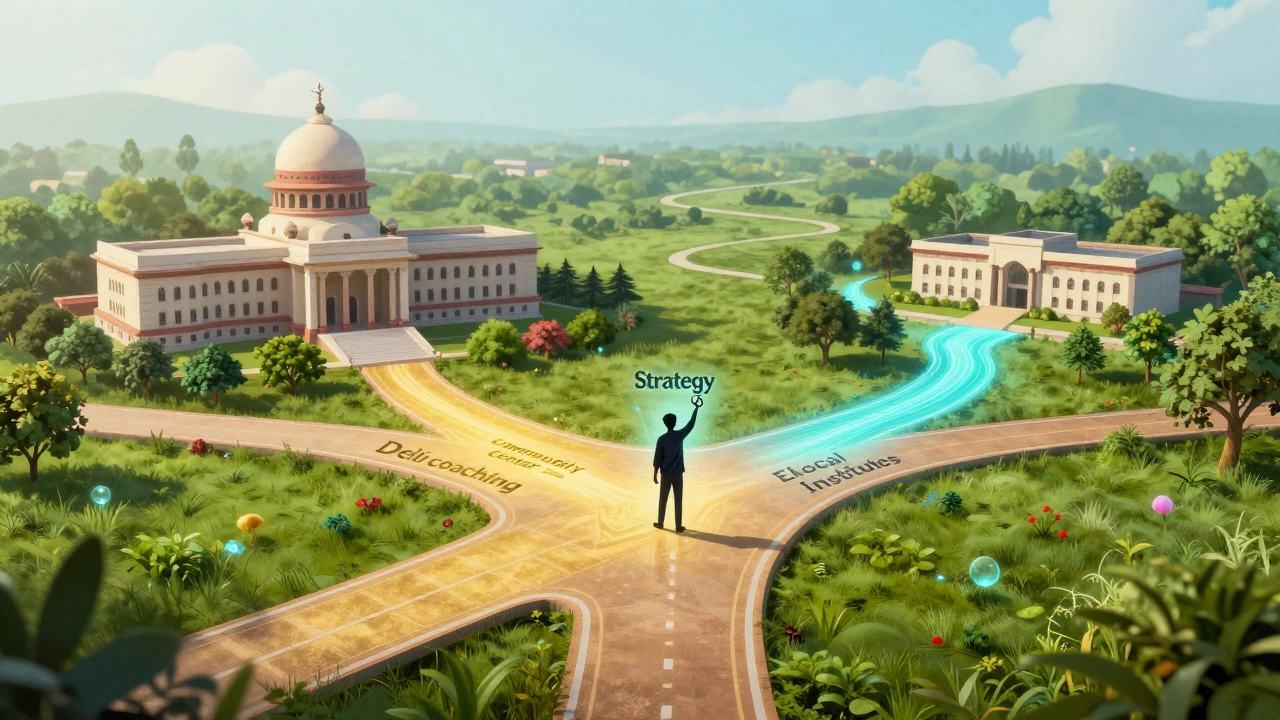
The Geographic Factor: Delhi vs. Other Hubs
For many aspirants, especially those targeting UPSC, New Delhi is considered the holy grail of coaching. The concentration of quality faculty, peer groups, and study resources in areas like Chanakyapuri and Rajendra Nagar is unmatched. Being surrounded by serious competitors creates a positive pressure that can boost your motivation.
However, moving to Delhi is expensive. Rent, food, and travel costs can drain your savings before you even take the first mock test. If you are from a tier-2 or tier-3 city, you might find excellent local institutes that offer better value for money. Cities like Patna, Hyderabad, and Chandigarh have emerged as strong alternatives with high-quality coaching centers that cater to both state-level and central government exams.
Consider this: if you are preparing for a State Public Service Commission (PSC) exam, staying in your home state makes more sense. Local institutes will have better insights into the state-specific syllabus, current affairs, and cultural nuances that often appear in these exams. They also tend to have networks with former candidates who can provide insider tips.
Evaluating Faculty and Study Material
The quality of an institute is directly tied to its teachers. But how do you judge a teacher? Don't rely on their credentials alone. A PhD in History does not automatically make someone a good UPSC mentor. Look for teachers who simplify complex topics. Can they explain the intricacies of the Indian Constitution in a way that sticks in your mind? Can they break down economic policies into digestible chunks?
- Teaching Style: Attend a demo class. Most reputable institutes offer free trial sessions. Pay attention to whether the teacher engages with students or just reads from slides.
- Availability: Are teachers accessible after class? Doubt-solving sessions are crucial. If a teacher disappears after the lecture ends, you are left stranded with half-understood concepts.
- Material Quality: Check the study material provided. Is it updated regularly? Does it include current affairs integration? For exams like UPSC, static knowledge is only half the battle; dynamic current affairs make up the other half.
Some institutes create their own proprietary notes, while others rely on third-party publications. Proprietary notes can be advantageous if they are concise and well-researched, but they can also be outdated if not maintained properly. Ask for a sample chapter to evaluate the depth and clarity of the content.

The Importance of Test Series and Feedback
This is where many institutes fall short. Attending lectures is passive learning. Taking tests is active learning. A robust test series is the backbone of any successful preparation plan. It simulates the actual exam environment, helping you manage time and reduce anxiety.
But taking tests is not enough. You need detailed analysis. When you submit a mock answer, do you get generic comments like "good effort" or specific feedback like "your introduction was weak, and you missed citing Article 370"? The latter is invaluable. It points out your blind spots so you can fix them before the real exam.
Look for institutes that offer:
- Regular Mock Tests: Weekly or bi-weekly tests aligned with the exam pattern.
- Detailed Evaluation: Personalized feedback on each answer, preferably by subject experts.
- All-India Ranking: Knowing where you stand among thousands of other aspirants gives you a realistic benchmark of your performance.
- Performance Analytics: Dashboards that show your strengths, weaknesses, and progress over time.
For objective exams like SSC and Banking, speed drills and sectional tests are essential. For descriptive exams like UPSC, answer writing practice with expert evaluation is non-negotiable.
Online vs. Offline: The Modern Dilemma
The rise of digital education has changed the landscape significantly. Online platforms offer flexibility, affordability, and access to top-tier faculty regardless of location. You can learn from the best teachers in Delhi while sitting in your hometown. Recorded lectures allow you to pause, rewind, and revise at your own pace.
However, online learning requires high self-discipline. Without the physical presence of peers and teachers, it is easy to procrastinate. The lack of immediate interaction can also hinder doubt resolution. Hybrid models, which combine online lectures with offline test series and counseling, are becoming increasingly popular. They offer the best of both worlds: convenience and accountability.
When evaluating online options, check the platform's user interface. Is it easy to navigate? Are the videos high quality? Does the app work smoothly on mobile devices? Technical glitches during live classes can be frustrating and disrupt your learning flow.
Comparing Top Contenders
| Feature | Traditional Offline (Delhi-based) | Local City Institutes | Online Platforms |
|---|---|---|---|
| Cost | High (tuition + living expenses) | Moderate | Low to Moderate |
| Peer Interaction | Excellent | Good | Limited (forum-based) |
| Flexibility | Low (fixed schedule) | Moderate | High (self-paced) |
| Faculty Access | Direct, frequent | Variable | Limited (Q&A forums) |
| Best For | UPSC, serious aspirants with budget | State PSCs, SSC | Banking, working professionals |
Use this table as a starting point, but remember that individual experiences vary. A highly disciplined student might thrive online, while another might need the structure of a classroom. Know your learning style.
Red Flags to Watch Out For
Not all institutes are created equal. Some prioritize profit over pedagogy. Here are some warning signs that should make you reconsider:
- Guaranteed Selection Promises: No legitimate institute can guarantee a job. Government exams are merit-based. Anyone promising results is likely running a scam.
- Hidden Fees: Ensure the quoted price includes all materials, test series, and counseling. Surprise charges later can strain your finances.
- Outdated Syllabus: If the study material references old events or laws that have since been amended, the institute is not keeping up with current trends.
- High Teacher Turnover: Frequent changes in faculty indicate instability and can disrupt your learning continuity.
- Lack of Transparency: If they refuse to share past results or let you meet the faculty, proceed with caution.
Always talk to former students. Their honest reviews, found on social media groups or independent forums, are more reliable than testimonials displayed on the institute's website.
Making the Final Decision
Choosing the best institute for government job preparation is a personal decision. It depends on your financial situation, learning preferences, and target exam. Start by narrowing down your exam choice. Then, research institutes that specialize in that area. Visit them, attend demo classes, and speak to current students. Compare their offerings against your needs.
Remember, the institute is just a tool. Your success ultimately depends on your consistency, hard work, and smart strategy. The best institute is the one that keeps you motivated, provides clear guidance, and holds you accountable. Once you find that balance, you are well on your way to cracking the exam.
Is it necessary to join a coaching institute for government job preparation?
No, it is not strictly necessary. Many successful candidates are self-taught. However, institutes provide structure, curated study material, and a competitive environment, which can significantly speed up the preparation process, especially for beginners who may struggle with planning and resource selection.
Which is better: online or offline coaching for UPSC?
Offline coaching in hubs like Delhi offers superior peer interaction and immediate faculty access, which is beneficial for answer writing and discussion. Online coaching offers flexibility and lower costs. For UPSC, a hybrid approach or offline coaching is often preferred due to the need for rigorous answer evaluation and debate.
How much does government job coaching typically cost?
Costs vary widely. Online programs can range from $50 to $300 per year. Local offline institutes may charge $500 to $1,500. Premium Delhi-based UPSC coaching can exceed $3,000 to $5,000 including accommodation. Always factor in hidden costs like books and additional test series.
Can I prepare for multiple government exams simultaneously?
Yes, to some extent. Exams like SSC CGL, UPSC Prelims, and State PSCs share common subjects like General Studies, History, Geography, and Polity. However, specialized exams like Banking require distinct quantitative and reasoning skills. Focus on one primary exam and use overlapping subjects to benefit secondary preparations.
What is the ideal duration for government job preparation?
For UPSC, 12-18 months of dedicated preparation is typical. For SSC and Banking exams, 6-9 months is usually sufficient. This assumes 6-8 hours of daily study. Consistency matters more than cramming; spread your syllabus coverage evenly to avoid burnout.