How to Choose the Best NEET Teacher: A Practical Guide for Students

NEET Teacher Compatibility & Readiness Assessor
Answer these 5 quick questions based on your honest self-reflection. This tool helps you align your choice of coaching with your actual needs, rather than just brand names.
Your Profile Assessment
Recommendation
0%Key Teacher Traits to Look For:
Subject-Specific Advice:
Complete the Form
Fill out the 5 questions on the left to see your personalized coaching recommendation.
Walking into a coaching center or logging onto an online platform for NEET is the National Eligibility cum Entrance Test, a mandatory exam for admission to undergraduate medical courses in India, you aren't just buying a course. You are hiring a guide for one of the most high-stakes academic journeys in the country. The difference between a top scorer and a ranker who falls short often isn't raw intelligence; it's the quality of instruction they received. But with thousands of teachers claiming to be the "best," how do you actually pick the right one? It’s not about finding a celebrity name. It’s about finding a teaching style that clicks with your brain.
Defining What Makes a Great NEET Mentor
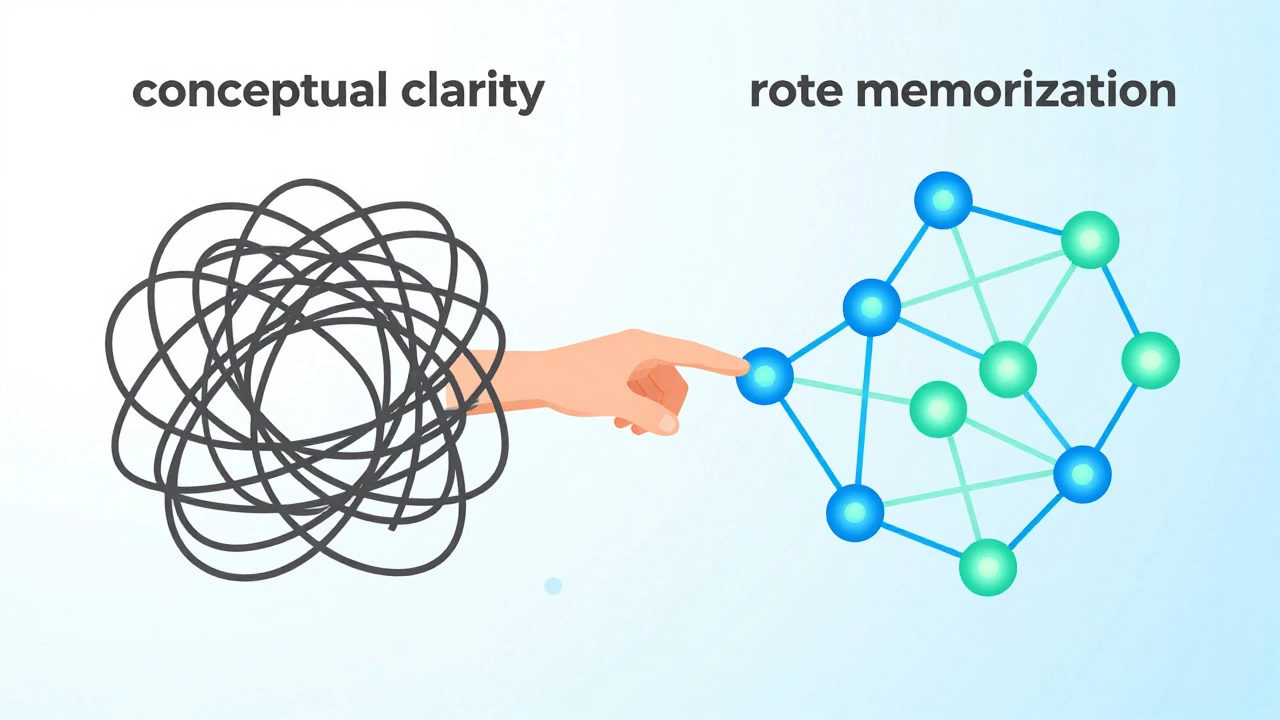
Before you look at names, you need to define what "good" looks like for you. A great NEET teacher is an educator who simplifies complex biological, chemical, and physical concepts while maintaining rigorous accuracy aligned with the NTA syllabus. They don't just read from slides. They connect dots. For example, when teaching organic chemistry, a mediocre teacher lists reactions. A great teacher explains the why behind electron movement, so you can predict products even if you forget the specific reaction. This conceptual clarity is crucial because the National Testing Agency (NTA) has shifted towards application-based questions in recent years. If a teacher only focuses on rote memorization, you are setting yourself up for failure in the final two hours of the exam.
The Three Pillars of Effective Instruction
When evaluating potential mentors, look for three specific traits. These are the non-negotiables that separate effective coaches from those who just fill seats.
- Syllabus Alignment: Since 2020, the NEET syllabus has been reduced based on Class 11 and 12 NCERT textbooks. Your teacher must strictly adhere to this. If they spend 40% of their time on advanced topics beyond NCERT, they are wasting your time. Verify that their content maps directly to the latest NTA guidelines.
- Explanation Clarity: Can they explain a difficult concept like thermodynamics or human physiology in simple language? Ask for a demo class. Watch how they handle a student's confusion. Do they get frustrated? Do they repeat the same point without changing their approach? Patience and adaptability are key indicators of a good mentor.
- Assessment Strategy: Teaching is only half the battle. The other half is testing. Does the teacher provide regular, timed mock tests? More importantly, do they analyze your mistakes? A teacher who helps you build a "mistake log" and reviews it weekly is far more valuable than one who just gives you a scorecard.
Online vs. Offline: Which Environment Fits You?
The debate between physical coaching centers and digital platforms is ongoing, but the "best" choice depends entirely on your learning style and logistical constraints. Both have distinct advantages that impact your preparation efficiency.
| Feature | Offline (Physical Centers) | Online (Digital Platforms) |
|---|---|---|
| Flexibility | Fixed schedule, travel time required | Recorded lectures available anytime, pause/replay features |
| Interaction | Immediate face-to-face doubt resolution | Asynchronous forums, live Q&A sessions (delayed response) |
| Cost | Higher (includes infrastructure costs) | Generally lower, multiple subscription tiers |
| Discipline | External structure enforces routine | Requires high self-motivation and time management |
| Resource Access | Limited to provided books/materials | Instant access to updated PDFs, previous year papers, video archives |
If you struggle with self-discipline, an offline center might provide the necessary accountability. However, if you are a self-starter who learns faster by watching a lecture three times until it makes sense, online platforms offer unparalleled control over your pace. Many top performers now use a hybrid model: attending live classes for interactive subjects like Physics and using recorded videos for Biology revision.
Subject-Specific Strengths: Finding Specialists
Rarely is one person the absolute best in all three subjects: Physics, Chemistry, and Biology. Often, the "best teacher" is actually a team of specialists. When choosing a coaching institute or online bundle, check the credentials of each subject head.
Biology constitutes 50% of the NEET paper. Here, precision is everything. Look for teachers who emphasize NCERT line-by-line reading. A strong Biology coach will drill you on diagrams, exceptions, and specific numerical values found in the textbook. They should be able to tell you exactly which paragraphs in Chapter 13 of Class 12 Botany are frequently asked.
Physics requires problem-solving speed. A good Physics teacher doesn't just solve problems; they teach shortcuts and estimation techniques. They should focus heavily on kinematics, electrostatics, and modern physics, as these units carry significant weight. Check if they provide a dedicated question bank for numerical practice, as theory alone won't save you in this section.
Chemistry is split into Physical, Organic, and Inorganic. This is where students often feel overwhelmed. A top-tier Chemistry coach will break this down clearly. For Inorganic Chemistry, they should provide mnemonic devices and trend charts. For Organic, they should focus on reaction mechanisms rather than just listing reagents. Ensure your chosen mentor has a proven track record in balancing these three sub-sections effectively.

Red Flags to Watch Out For
Not every famous name is right for you. Be wary of certain marketing tactics that hide poor pedagogical practices.
- Guaranteed Ranks: No honest teacher can guarantee a specific rank. If a brochure promises "Top 100 Rank Guaranteed," view it with skepticism. Results depend on your effort, health, and consistency.
- Outdated Material: Check the copyright dates of their books and the release dates of their video lectures. If their core material hasn't been updated since the last major syllabus change, you are studying obsolete content.
- Lack of Doubt Support: If the process for resolving doubts is vague or involves waiting days for a reply, avoid it. In NEET preparation, a stuck concept can snowball into a weak area that costs you 20-30 marks.
- One-Size-Fits-All Approach: If the teacher speaks too fast for beginners or too slow for advanced students without offering alternative resources, their method may not suit your level.
How to Evaluate Before You Commit
Don't buy on impulse. Use this practical checklist to vet any potential NEET coaching provider before paying a single rupee.
- Attend a Demo Class: Most reputable institutions offer free trial weeks. Sit through at least one full session per subject. Take notes. See if the explanation sticks.
- Talk to Current Students: Find current students on social media groups or local forums. Ask them specifically: "How helpful were the test series?" and "Did the teachers address individual weaknesses?"
- Check Past Year Performance Data: Don't just look at the number of toppers. Look at the percentile distribution. Did a large portion of their batch clear the cutoff? A teacher who produces consistent mid-range performers is often more reliable than one who produces a few outliers.
- Review the Question Bank Quality: Ask for sample questions. Are they aligned with the NTA pattern? Do they include assertion-reason type questions, which have become increasingly common?
Choosing the best NEET teacher is less about finding a guru and more about finding a partner in your preparation. The right mentor will respect your time, simplify complexity, and hold you accountable. Whether you choose a renowned offline academy or a flexible online platform, ensure the core teaching methodology aligns with your personal learning needs. Your success in the medical entrance exam hinges on this foundational decision, so take your time, ask hard questions, and make an informed choice.
Is it better to have one teacher for all subjects or different teachers for each?
For NEET, it is generally better to have specialized teachers for each subject. Physics, Chemistry, and Biology require different teaching approaches. A specialist in Biology, for instance, will have deeper knowledge of NCERT nuances and exam-specific traps than a generalist. Look for institutes that assign dedicated faculty for each discipline.
How much does a good NEET coaching teacher cost in 2026?
Costs vary significantly by location and mode. Offline premium institutes in metro cities can range from ₹1.5 lakh to ₹3 lakh per year. Online platforms typically range from ₹30,000 to ₹80,000 for comprehensive annual packages. The price should reflect the quality of test series and doubt-clearing support, not just the brand name.
Can I learn NEET effectively without a formal teacher?
Yes, but it requires extreme self-discipline. You would need to rely on NCERT textbooks, high-quality YouTube channels, and independent mock tests. However, a teacher provides structure, accountability, and personalized feedback, which many self-students lack. If you are highly motivated and have access to good resources, self-study is viable, but it carries a higher risk of inconsistent progress.
What qualifications should a NEET teacher have?
While there is no single statutory requirement, look for teachers with a background in B.Sc., M.Sc., or MBBS/BDS degrees in the relevant subject. More importantly, check their teaching experience specifically in competitive exams. A doctor who has taught NEET for 5+ years is generally more effective than a fresh graduate with high academic scores but no teaching track record.
How often should I switch my NEET coaching if it's not working?
Give any new coaching program at least 3 months before judging its effectiveness. It takes time to adjust to a new teaching style and see results in mock test scores. If after 3 months, your scores are stagnant or declining, and you haven't resolved your doubts, it may be time to switch. Frequent switching, however, disrupts your study rhythm and should be avoided unless absolutely necessary.