What is the Lowest Federal Government Salary in the US?

Federal Salary & Grade Estimator
Select your qualifications above to see estimated starting grades and salaries.
Recommended Entry Grade:
GS-?
You see a job posting on USAJOBS that looks perfect. It’s stable, has great benefits, and you’re ready to apply. But then you spot the pay range: $25,000 to $38,000. Your eyes widen. Is that really enough to live on? You might be wondering if there’s a floor-a minimum wage for working for Uncle Sam. The short answer is yes, but it’s not as simple as a single number. The lowest federal government salary depends entirely on where you work, what grade you’re hired at, and whether you have a college degree.
The Absolute Floor: Grade GS-1 Step 1
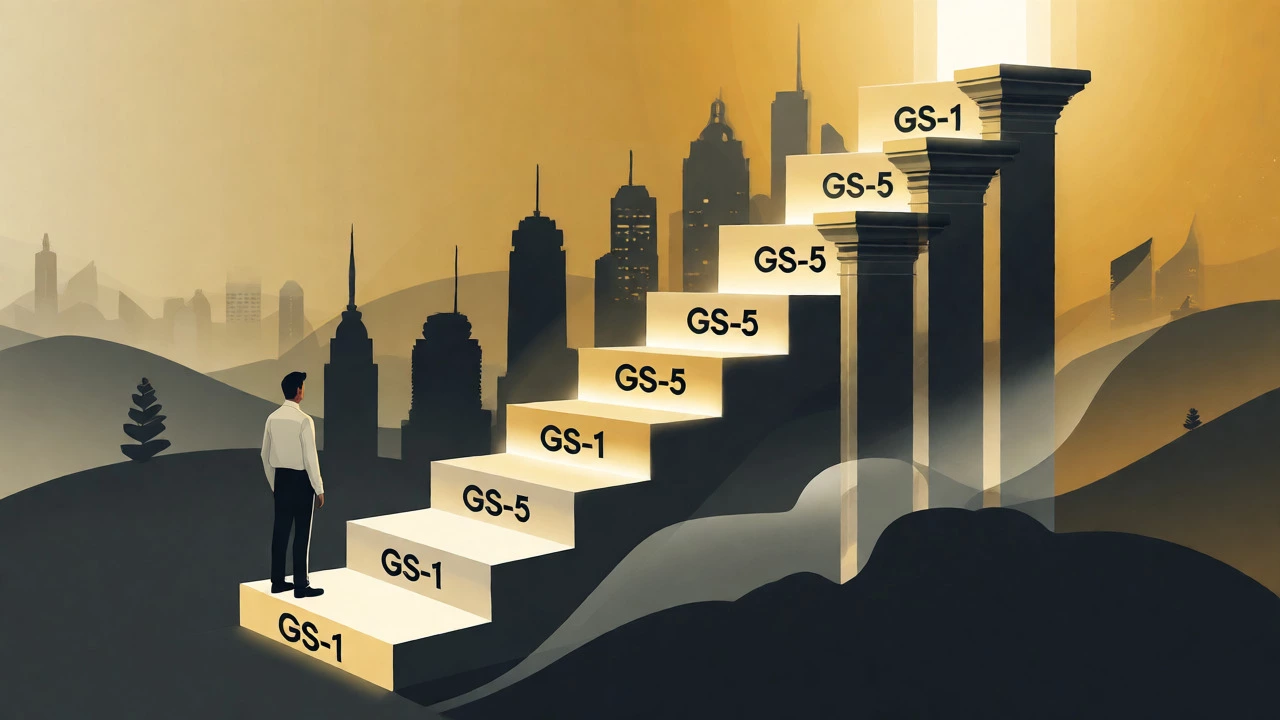
The federal pay system uses a General Schedule (GS) scale. Think of it as a ladder with 15 rungs, called "grades." The very bottom rung is Grade GS-1. This is the entry-level tier for jobs that require no specialized experience or education beyond high school. If you are hired directly into a GS-1 position, you start at Step 1. As of the most recent adjustments leading into 2026, the base rate for this role sits just under $25,000 annually. However, this base rate is rarely what you actually take home because geography matters immensely.
Federal salaries are adjusted based on locality pay. If you work in Washington D.C., San Francisco, or New York City, your paycheck will be significantly higher than someone doing the exact same job in rural Alabama. For example, while the base GS-1 Step 1 might be around $24,700, adding the locality adjustment can push that figure closer to $30,000 or more in high-cost areas. Conversely, in regions with low cost-of-living adjustments, you stay near the national base. So, when asking "what is the lowest," you must ask "where?"
| Pay Grade | Typical Education/Experience | Approx. Base Annual Salary | High-Cost Area Adjusted Salary |
|---|---|---|---|
| GS-1 | No experience; High School Diploma | $24,700 - $25,500 | $30,000+ |
| GS-2 | 1 year experience OR Superior Academic Achievement | $27,700 - $28,500 | $33,000+ |
| GS-3 | 2 years exp OR Bachelor's Degree | $30,900 - $31,800 | $37,000+ |
| GS-4 | 3 years exp OR Superior Academic Achievement | $34,600 - $35,500 | $41,000+ |
Why Most "Entry-Level" Jobs Are Actually GS-5 or Higher
Here is a trap many new applicants fall into. They search for "entry-level" jobs and assume they should look at GS-1. In reality, most professional federal jobs labeled "entry-level" start at GS-5 or GS-7. Why? Because these roles usually require a bachelor’s degree. If you have a four-year degree from an accredited university, you qualify for higher starting grades without needing prior work experience. This is known as "Superior Academic Achievement."
If you apply for a GS-1 job with a bachelor’s degree, you are likely underemploying yourself. A GS-1 role is typically administrative support, mail handling, or basic labor. These jobs do not leverage your education. A GS-5 role, often titled "Administrative Assistant" or "Program Support Specialist," pays significantly more-starting around $42,000 base before locality adjustments. Before you accept the absolute lowest salary, check if your credentials allow you to jump several steps up the ladder immediately.
Specialized Job Series and Their Minimums
Not all federal jobs follow the standard GS scale. Some professions have their own pay tables. For instance, medical professionals like nurses and physicians use the Health Care System pay scales, which are generally much higher. But let’s stick to the common civil service roles. Even within the GS system, specific job series have different norms.
- Postal Service: Postal clerks and carriers often start lower, sometimes equivalent to GS-1 or GS-2 levels, but union contracts may guarantee specific raises faster than the standard GS step increases.
- Custodial and Labor: Jobs like janitors or maintenance workers often sit at GS-1 through GS-3. These are physically demanding roles that provide essential services but offer the lowest monetary compensation in the agency structure.
- Internships and Student Programs: If you are still in college, you might encounter Pathways Internship programs. These pay hourly rates tied to GS grades but are prorated. A GS-1 intern might earn roughly $12-$15 per hour depending on location.
It is crucial to read the vacancy announcement carefully. Look for the "Salary Range" field. If it says "GS-1," expect the lowest numbers. If it says "GS-5," expect a living wage in most mid-sized cities. Never guess; always verify the grade.
The Hidden Value: Benefits vs. Low Wages
So, why would anyone take a $25,000 job? Because the salary isn't the whole package. Federal employment comes with perks that private sector jobs paying $40,000 often lack. When calculating the true value of the lowest federal salary, you must factor in the benefits load.
Federal employees receive comprehensive health insurance, life insurance, and retirement plans. The government contributes a significant portion to your pension. Additionally, you get paid holidays, sick leave, and annual leave that accrues over time. A GS-1 employee gets about 13 days of vacation after one year, increasing to 20 days after three years. In the private sector, a low-wage worker might get zero paid vacation. Over a ten-year career, those benefits can add tens of thousands of dollars to your total compensation. If you are young and willing to sacrifice cash flow for stability and long-term security, the lowest salary might still be a smart move.

How to Move Up Fast From the Bottom
Starting at the lowest salary doesn’t mean staying there forever. The federal system rewards tenure and performance. Each year, if your performance review is satisfactory, you move up one "step" within your grade. A GS-1 Step 1 becomes GS-1 Step 2 next year, earning a small raise. After five years, you reach Step 5. Then, you become eligible for promotion to GS-2. This process repeats.
To accelerate this, consider applying for positions that offer "Career Ladder" promotions. Some job announcements explicitly state that successful candidates will be promoted automatically to GS-2, then GS-3, etc., upon completing training. This removes the need to compete against external candidates every year. Another strategy is to pursue additional education. Many agencies offer tuition assistance. Earning a master’s degree can sometimes qualify you for a higher starting grade if you change jobs later.
Key Takeaways for Applicants
- Know your grade: The lowest possible salary is at GS-1 Step 1, roughly $25k base.
- Location changes everything: High-cost areas add 15-30% to the base pay.
- Degrees matter: Don't settle for GS-1 if you have a bachelor's; aim for GS-5 or GS-7.
- Benefits offset low wages: Calculate total compensation, not just the paycheck.
- Check for career ladders: Look for jobs with automatic promotions to avoid stagnation.
Is the federal minimum wage higher than the lowest federal salary?
No. The federal minimum wage for general employment is $7.25 per hour. However, the lowest federal government salary (GS-1 Step 1) equates to roughly $12-$13 per hour when annualized. Federal employees are exempt from the standard federal minimum wage law because their pay is set by the General Schedule, which is significantly higher than the statutory minimum.
Can I negotiate my starting salary at GS-1?
Generally, no. Federal hiring follows strict pay-setting rules. You cannot negotiate the base GS grade or step during the initial hiring process unless you have specific, documented specialized experience that qualifies you for a higher step. For a pure GS-1 entry, you will almost certainly start at Step 1.
Does overtime count toward the lowest salary calculation?
The "lowest salary" figures refer to base pay only. Overtime is calculated separately. GS-1 through GS-10 employees are typically non-exempt, meaning they receive overtime pay at 1.5 times their hourly rate for hours worked over 40 in a week. This can significantly boost actual earnings above the stated base salary.
Are there jobs below GS-1?
Yes, technically. There are Wage Grade (WG) positions, often referred to as Federal Wage System jobs, primarily for trades and laborers. These can sometimes pay less than GS-1 depending on the local market survey, but they are distinct from the white-collar General Schedule. Most "office" or "administrative" entry jobs are GS-1 or higher.
How often does the lowest salary increase?
Federal pay scales are reviewed annually. Adjustments depend on Congressional approval and economic indicators. Typically, there is a small across-the-board increase each January, followed by locality-specific adjustments later in the year. Expect modest raises of 1-3% annually, barring major inflation spikes.