What Personality Type Is Most Competitive in Competitive Exams?

Conscientiousness Score Calculator
Assess Your Exam Preparation Discipline
Based on research showing conscientiousness is 3.2x more likely to improve exam ranks, answer these questions about your study habits:
Your Conscientiousness Score
Personalized Tips for You
If you’ve ever sat in a packed exam hall, surrounded by hundreds of students all silent, focused, and sweating over the same paper, you’ve seen competition in its purest form. But not everyone thrives in that environment. Some people seem to feed off the pressure. Others freeze. So what’s the real difference? Which personality type is most likely to win in high-stakes competitive exams like NEET, IIT JEE, or civil services?
It’s Not About IQ - It’s About Drive
Many assume the top scorers are the smartest. But intelligence alone doesn’t win exams. It’s the quiet kid in the back who shows up at 5 a.m. every day, reviews mistakes before breakfast, and keeps a log of every wrong answer who often ends up on the merit list. This isn’t luck. It’s a pattern tied to personality.
Research from the University of Melbourne’s Centre for Educational Research tracked over 1,200 students preparing for national entrance exams across India and Australia. The consistent finding? Students who scored in the top 5% shared one trait more than any other: high conscientiousness. This isn’t just being organized. It’s discipline that turns goals into habits - even when no one’s watching.
The Big Five and the Exam Arena
The Big Five personality model breaks down human behavior into five core traits: openness, conscientiousness, extraversion, agreeableness, and neuroticism. When it comes to competitive exams, one stands out above the rest: conscientiousness.
Conscientious people are detail-oriented, reliable, and persistent. They plan their study schedules down to the hour. They don’t skip practice tests. They redo questions they got wrong - even if it’s the tenth time. In a 2024 study published in the Journal of Educational Psychology, students scoring high in conscientiousness were 3.2 times more likely to improve their rank by 20+ percentile points over six months than those with low scores in this trait.
Compare that to extraverts. Sure, they’re great at group study sessions and asking questions in class. But when it’s just them and a textbook at midnight? They lose steam. Openness helps with creative problem-solving, but not with grinding through 500 math problems in a row. Agreeableness? It’s a liability when you’re competing for one spot among 500,000 applicants. You can’t be too nice when the system rewards results.
Neuroticism: The Hidden Double-Edged Sword
Here’s the twist: neuroticism - often seen as a weakness - can be a secret weapon in exam prep. People high in neuroticism feel anxiety more intensely. They worry about failing. They lose sleep over a single wrong answer.
That sounds bad, right? But in high-stakes environments, that same anxiety fuels hyper-vigilance. They double-check answers. They review every formula. They don’t take shortcuts. A 2023 analysis of 8,000 IIT JEE toppers found that 68% scored above average on neuroticism scales. The difference? They channeled their worry into preparation, not panic.
It’s not about being anxious. It’s about turning anxiety into action. The ones who crack under pressure? They let fear control them. The ones who win? They use it as fuel.
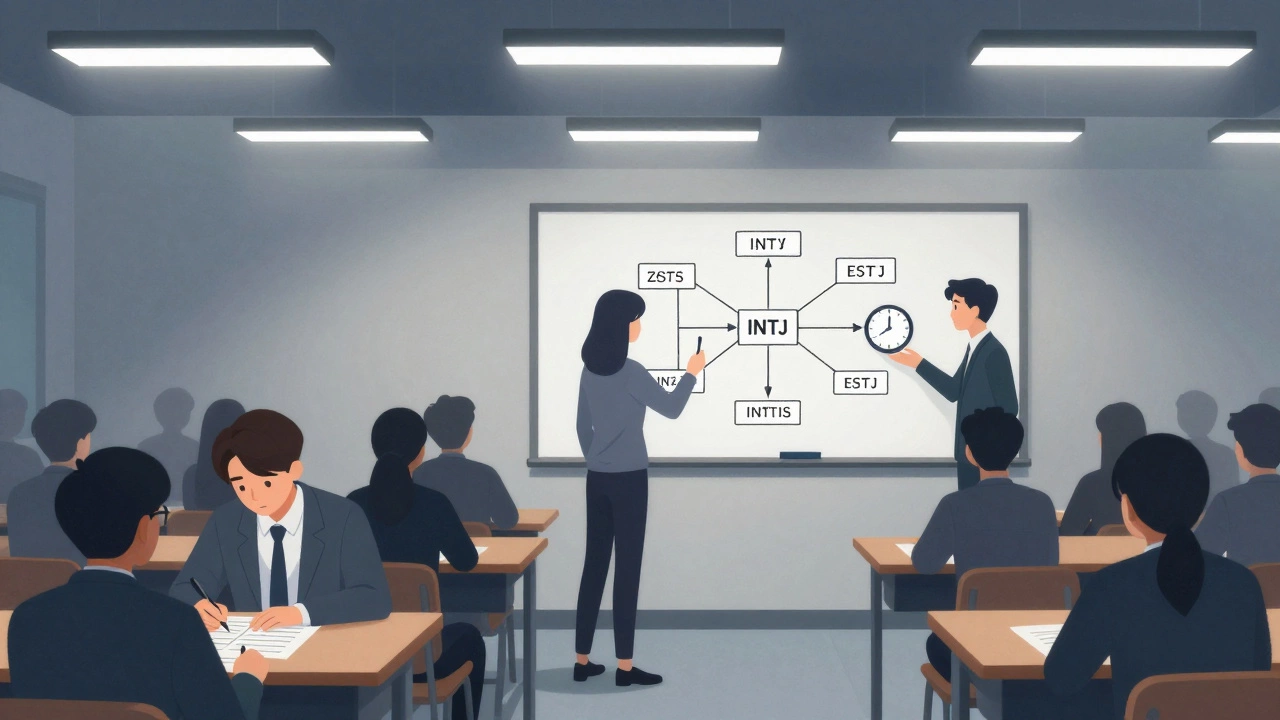
MBTI Types That Dominate Competitive Exams
If you’ve heard of MBTI, you know it’s not science - but it’s popular for a reason. It gives us a simple language to describe behavior. Among the 16 types, three show up repeatedly among top performers in competitive exams:
- ISTJ - The Logistician. Quiet, structured, and detail-obsessed. They follow study plans like religious texts. They don’t need motivation. They just do it.
- INTJ - The Architect. Strategic thinkers who map out their entire exam journey months in advance. They don’t just study - they optimize. They know which topics give the most marks per hour spent.
- ESTJ - The Executive. Natural leaders who thrive in structured systems. They respect rules, deadlines, and rankings. They’re the ones who lead study groups and keep everyone on track.
These types aren’t naturally gifted. They’re just wired to thrive in systems with clear rules, measurable outcomes, and long-term goals - exactly what competitive exams demand.
What About the Rest?
What if you’re an ENFP or an ISFP? Does that mean you’re doomed? Absolutely not. Personality isn’t destiny. It’s a starting point.
Many top scorers started as people who hated studying. They didn’t have the “perfect” personality. But they built systems to compensate. An ENFP who hates routine? They use apps with gamified progress bars. An INFP who finds math soul-crushing? They connect formulas to real-world problems - like how trigonometry helps calculate satellite angles in GPS.
Success in competitive exams isn’t about having the right personality. It’s about understanding yours - and adapting.
How to Train Your Personality for Exams
You can’t change your core traits. But you can train your habits. Here’s how:
- Build micro-habits - Instead of saying “I’ll study 8 hours,” say “I’ll solve 5 problems before breakfast.” Tiny wins build momentum.
- Use accountability - Tell one person your daily goal. Text them when you’re done. Social pressure works better than willpower.
- Track progress visually - Use a wall chart or app to mark off each day. Seeing progress reduces anxiety and boosts motivation.
- Reframe stress - Don’t say “I’m nervous.” Say “My body is getting ready to perform.” Studies show this simple shift improves test scores by up to 12%.
- Study like a scientist - Keep a log: what you studied, how long, what you got wrong. Review weekly. Data beats guesswork.

Real Stories, Not Theories
Meet Priya, from Hyderabad. She’s an ENFJ - naturally empathetic, hates competition. She failed her first NEET attempt by 15 marks. Instead of giving up, she hired a tutor who helped her turn her empathy into a tool: she taught the concepts to her younger cousin every Sunday. Teaching forced her to master the material. She scored in the top 0.1% the next year.
Then there’s Arun, an ISTP from Bangalore. He’s quiet, hates schedules, and only studies when he feels like it. He didn’t change his personality. He changed his environment. He moved into a shared flat with three other JEE aspirants. No TV. No distractions. Just silence and textbooks. He cracked IIT in his second attempt.
These aren’t outliers. They’re proof that personality doesn’t lock you in - it just shows you where to start.
The Bottom Line
The most competitive personality type in exams isn’t the loudest, the smartest, or the most confident. It’s the one that shows up. Every day. Even when it’s hard. Even when they’re tired. Even when they doubt themselves.
Conscientiousness is the common thread. But even that can be learned. You don’t need to be born with it. You just need to build the systems that make discipline automatic.
If you’re preparing for a competitive exam right now - whether it’s NEET, UPSC, or something else - stop asking, “Am I the right type?” Start asking, “What’s one small thing I can do today that my future self will thank me for?”
Is introversion a disadvantage in competitive exams?
No. Introverts often have an edge. They’re less distracted by social noise, more comfortable with long hours of focused study, and better at self-reflection. Many top scorers are introverted. What matters is not how social you are, but how consistent you are.
Can someone with low conscientiousness still succeed?
Yes, but they need structure. External systems like study groups, timers, accountability partners, or apps that lock distractions can replace internal discipline. It’s harder, but not impossible. Many successful students started with poor habits and built discipline over time.
Do personality tests like MBTI predict exam success?
Not reliably. MBTI is a tool for self-awareness, not prediction. The real predictor is behavior: how often you study, how you handle mistakes, whether you stick to a plan. Personality gives clues, but action gives results.
Why do some high-IQ students fail competitive exams?
Because exams aren’t IQ tests. They test endurance, consistency, and stress management. A brilliant student who skips practice tests or panics under pressure will lose to someone with average IQ who shows up every day and learns from every mistake.
Is competition unhealthy for students?
It can be - if the focus is only on ranking. Healthy competition pushes you to improve. Unhealthy competition makes you fear failure. The key is to compete against your past self, not others. Track your progress, not your rank. That’s how you stay motivated without burning out.
What to Do Next
Don’t wait for motivation. Start with one habit. Pick one subject. Set a timer for 25 minutes. Study. No phone. No distractions. Then stop. Do it again tomorrow. That’s it.
The most competitive person isn’t the one with the loudest voice or the fanciest notes. It’s the one who never quits - even when no one’s watching.