Which State Has the Hardest Competitive Exams in India? A Data-Driven Look

State Exam Difficulty & Strategy Calculator
Select Your Target Exam
Did You Know?
Difficulty isn't just about the questions. In Bihar and UP, the sheer volume of applicants creates a statistical nightmare, whereas in Tamil Nadu, high precision is required due to strict negative marking.
You sit down with a stack of books, a highlighter, and a dream. You think you are ready for the challenge. Then you open the syllabus for your state’s recruitment board or the national civil services exam, and reality hits. The volume of material is staggering. The competition is fierce. But here is the question that keeps candidates awake at night: which state actually has the hardest tests?
There is no single answer because "hard" means different things to different people. For some, hard means a low pass rate. For others, it means an impossible-to-crack syllabus or millions of applicants fighting for a few hundred seats. In India, where government jobs are seen as the ultimate career stability, the difficulty varies wildly from one region to another.
Quick Summary: What Makes an Exam Hard?
- Competition Ratio: States like Bihar and Uttar Pradesh have millions of applicants for thousands of posts, making selection statistically harder.
- Syllabus Depth: Exams like the UPSC Civil Services require broad knowledge across history, science, and polity, unlike many state-level focused tests.
- Negative Marking: Some states penalize wrong answers heavily, increasing the mental pressure during the test.
- Cut-off Volatility: In high-demand states, cut-offs can jump by 10-15 marks year over year, making preparation unpredictable.
The Myth of the "Hardest" Exam
Before we point fingers at specific states, we need to define what we mean by difficulty. Is it the intellectual rigor of the questions? Or is it the sheer number of people trying to beat you? Most candidates confuse these two. An exam can be intellectually simple but statistically brutal because everyone else is also prepared. Conversely, an exam might have complex questions but fewer applicants, giving you a better shot if you study smart.
When experts talk about the hardest exams in India, they usually look at three metrics: the applicant-to-vacancy ratio, the average score required to qualify (cut-off), and the breadth of the syllabus. If you measure by pure numbers, the battle is between population giants. If you measure by academic depth, the conversation shifts to national-level bodies that oversee multiple states.
Bihar: The Statistical Nightmare
If you ask anyone who has faced the Bihar Public Service Commission (BPSC) or the Bihar Police recruitment drives, they will tell you it is a war zone. Bihar is often cited as having the most difficult competitive landscape not because the questions are quantum physics level, but because of the crowd.
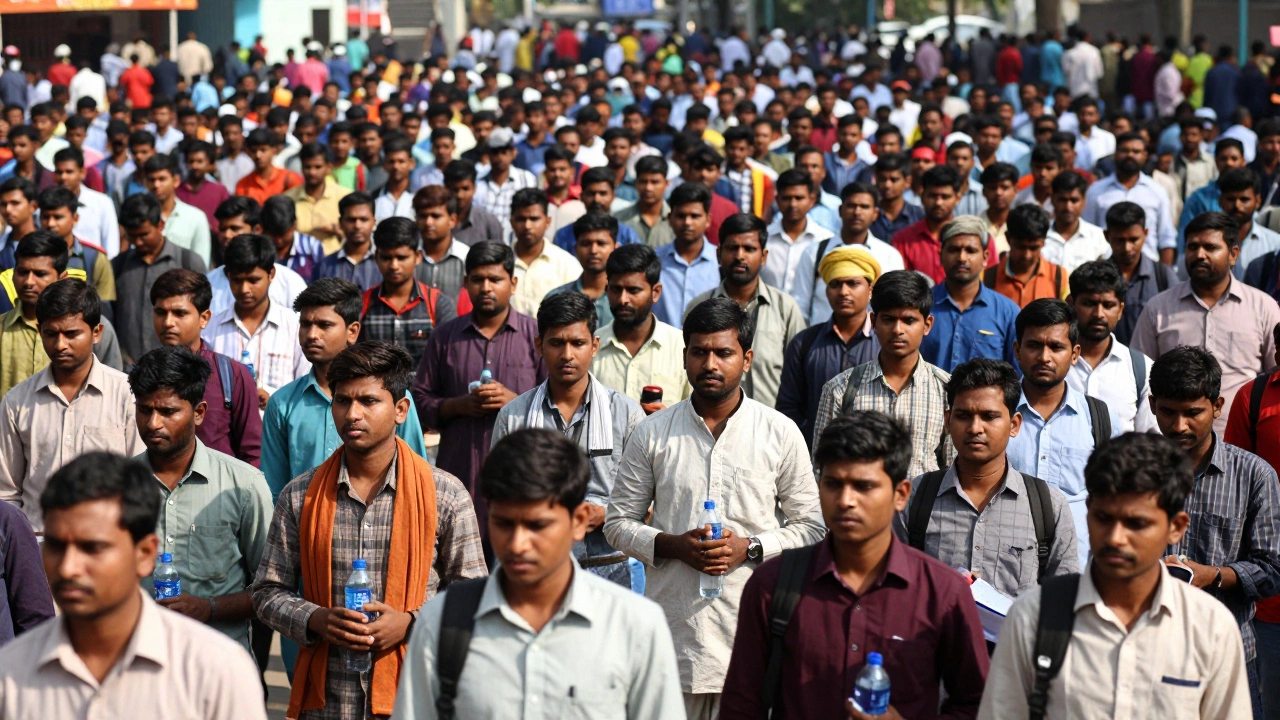
Consider the Bihar Police Constable exam. In recent cycles, over 2 million candidates applied for roughly 20,000 to 30,000 posts. That is a ratio of nearly 100:1. Now, imagine the Bihar Subordinate Services Commission (BSSC) exams. The competition is so intense that the cut-off marks hover dangerously high. You cannot just know the answers; you have to know them faster than 99% of the state's youth.
The pressure in Bihar is compounded by limited alternative employment opportunities in the private sector. This funnels almost every educated graduate into the government job pipeline. When supply of candidates vastly outstrips demand for jobs, the bar rises. It becomes less about merit and more about endurance. You are not just competing against your neighbor; you are competing against half the state.
Uttar Pradesh: The Volume Game
Next door to Bihar lies Uttar Pradesh, the most populous state in India. The Uttar Pradesh Public Service Commission (UPPSC) and the Uttar Pradesh Police Recruitment and Promotion Board handle some of the largest examinations in the world.
Why is UP considered tough? Scale. When the UPPCS (Uttar Pradesh Civil Services) exam releases its notification, lakhs of students register. The sheer volume creates a statistical anomaly. Even if you score well, the normalization process can hurt you if your shift was easier than others. This unpredictability adds a layer of psychological stress that doesn't exist in smaller states.
Furthermore, the syllabus for UPPCS overlaps significantly with the national-level UPSC exam. Candidates often prepare for both simultaneously. This means you are up against people who are studying 14 hours a day for years. The depth of preparation required to clear the mains and interview stages of UPPCS is immense. It requires writing skills, analytical ability, and vast general knowledge. It is not a test you can crack with a three-month crash course.
Madhya Pradesh: The Hidden Challenge
While Bihar and UP grab headlines, Madhya Pradesh presents a different kind of difficulty through its Madhya Pradesh Professional Examination Board (MPPEB) and the MPPSC.
MP is known for frequent changes in exam patterns and sudden cancellations or postponements. This instability makes preparation frustrating. One year, the focus might be on heavy reasoning; the next, it shifts to current affairs. Candidates must stay agile. The MP Police Bharti, similar to Bihar, sees massive turnout. However, the rural-urban divide in coaching access in MP means that self-study is often the only option for many, raising the barrier to entry for those without resources.
The difficulty here is logistical and strategic. You have to navigate a system that is constantly evolving. Unlike stable systems where past papers predict future trends perfectly, MP exams sometimes throw curveballs. This requires a deeper, more conceptual understanding rather than rote memorization of previous years' questions.
The National Giant: UPSC vs. State PSCs
We cannot talk about hard tests without mentioning the Union Public Service Commission (UPSC). While not a "state" exam, it recruits for all states and central ministries. It is widely regarded as the hardest exam in India, period.
Why? Because the syllabus is virtually unlimited. It covers everything from ancient Indian history to international relations, environmental science, and ethics. The success rate is often below 0.1%. Compare this to state PSCs, where success rates might range from 1% to 5% depending on the post. UPSC demands a lifetime of learning compressed into a few years of intense preparation.
However, many state PSCs are modeled after UPSC. For example, the Rajasthan PSC or Maharashtra PSC have started incorporating essay-type questions and descriptive papers that mimic the UPSC style. This trend is making state exams harder academically, even if the applicant pool is smaller than UPSC's.
| Exam Body | Primary Difficulty Driver | Avg. Applicant Ratio | Syllabus Breadth |
|---|---|---|---|
| UPSC (Central) | Academic Depth & Uncertainty | ~1000:1 (for IAS) | Extremely Broad |
| BPSC (Bihar) | Massive Competition Volume | ~100:1 to 500:1 | Moderate |
| UPPSC (UP) | Scale & Normalization Risks | ~200:1 | Broad (UPSC-like) |
| MPPSC (MP) | Pattern Instability | ~150:1 | Moderate to Broad |
| TNPSC (Tamil Nadu) | High Cut-offs & Precision | ~100:1 | Focused | d>

Tamil Nadu: The Precision Test
In South India, Tamil Nadu stands out with the Tamil Nadu Public Service Commission (TNPSC). The Group 1 and Group 2 exams here are notorious for their high cut-offs.
Unlike the north, where raw volume dominates, Tamil Nadu's difficulty lies in precision. The candidate pool is highly educated and well-prepared. Coaching centers in Chennai and Coimbatore are top-tier. To clear TNPSC Group 1, you often need scores above 85-90%. There is no room for error. The negative marking scheme is strict, and the questions are designed to trap those who guess. It is a test of accuracy, not just knowledge.
This creates a different kind of stress. In Bihar, you worry about being buried in the crowd. In Tamil Nadu, you worry about losing marks on silly mistakes. The psychological burden of maintaining near-perfect accuracy across hundreds of questions is immense.
How to Choose Your Battlefield
Knowing which state has the hardest tests helps you strategize. If you are from Bihar or UP, you might consider applying to neighboring states with lower populations, like Himachal Pradesh or Uttarakhand, if eligibility allows. These states often have lower cut-offs and less intense competition.
Alternatively, if you excel in deep analysis and writing, targeting UPSC or state PSCs with descriptive papers (like Maharashtra or Gujarat) might play to your strengths, avoiding the multiple-choice traps of mass-recruitment exams.
Diversification is key. Many successful candidates apply to 3-4 different exams simultaneously. They use the easier ones to build confidence and gain experience, while keeping their primary focus on the tougher, higher-reward exams.
Final Thoughts on Strategy
There is no "easiest" way to get a government job. Every path has its obstacles. The "hardest" exam is simply the one that mismatches your preparation style. If you hate crowds, avoid Bihar and UP police exams. If you struggle with broad general studies, avoid UPSC and UPPCS. Match your strength to the exam's weakness.
Remember, difficulty is subjective. For a strong writer, UPSC is manageable. For a quick calculator, SSC CGL might be easier. Know yourself, analyze the data, and pick your fight wisely.
Is BPSC really harder than UPSC?
Not academically, but statistically yes. UPSC has a broader syllabus and deeper questions, making it intellectually harder. However, BPSC has a much higher number of applicants per seat in many categories, making the selection process more competitive due to crowd size. Your success depends on whether you prefer deep study (UPSC) or high-volume competition management (BPSC).
Which state has the lowest cut-off marks?
States with smaller populations and fewer aspirants, such as Sikkim, Arunachal Pradesh, or Mizoram, often have lower absolute cut-off marks. However, the percentage required might still be high relative to the total marks. Generally, northeastern states and hill states like Himachal Pradesh offer slightly lower competition ratios compared to Bihar, UP, or Tamil Nadu.
Does negative marking make an exam harder?
Yes, significantly. Exams like TNPSC and various state police exams use strict negative marking (often 0.25 or 0.5 marks deducted). This forces candidates to be certain before answering. It increases anxiety and reduces the strategy of "educated guessing," effectively raising the difficulty level for average performers.
Can I appear for state exams outside my home state?
Most state public service commissions allow candidates from any part of India to apply, provided they meet the educational qualifications. However, some reserved posts or specific local-language requirements may restrict eligibility. Always check the official notification for "Domicile" or "Residency" clauses before investing time in preparation.
What is the best strategy for cracking high-difficulty state exams?
Focus on consistency over intensity. Study daily for 6-8 hours rather than cramming. Use previous year questions (PYQs) to understand the pattern. For states like Bihar and UP, speed and accuracy in General Knowledge are crucial. For states like Tamil Nadu, precision and elimination techniques are key. Mock tests are non-negotiable to simulate exam pressure.