Why Are Group Service (GS) Salaries So Low? The Truth About Government Pay Scales

Government Salary Estimator
Salary Parameters
Estimated Monthly Breakdown
Earnings
Deductions
You just cleared the exam. You beat thousands of competitors to secure that coveted government position. But then you see the salary slip, and something feels off. It’s not the six-figure package you were promised in the recruitment brochure. In fact, it might look shockingly low compared to what your friends in the private sector are earning. This is the reality for many new entrants into Group Service (GS) roles within the Indian government framework.
The question isn't just "why is it low?" but rather, "how does this structure actually work, and where does the money go?" To understand why GS salaries appear low on paper, we have to peel back the layers of the 7th Central Pay Commission (CPC), the hidden deductions, and the non-monetary benefits that don't show up in a simple bank transfer.
The Myth of the "Basic Pay" vs. Take-Home Reality
The biggest reason GS salaries seem low is that most people only look at the Basic Pay. If you join as a Group C or lower-level Group B officer, your basic pay might start around ₹18,000 to ₹25,000 per month. On its own, that number is terrifyingly small for a professional role. However, basic pay is just the foundation. It is not your income.
Your actual take-home salary includes several allowances that significantly boost the figure. These include Dearness Allowance (DA), House Rent Allowance (HRA), and Travel Allowance (TA). For example, if DA is set at 46% (a common recent benchmark), that adds nearly half again to your base amount. HRA can add another 24% to 27% depending on whether you live in a metro city like Mumbai or Delhi, or a smaller town. When you stack these up, the monthly credit to your bank account often lands between ₹35,000 and ₹50,000 for entry-level posts. That is decent, but still lags behind tech startups or management roles in private firms.
The Invisible Tax: Deductions That Shrink Your Wallet
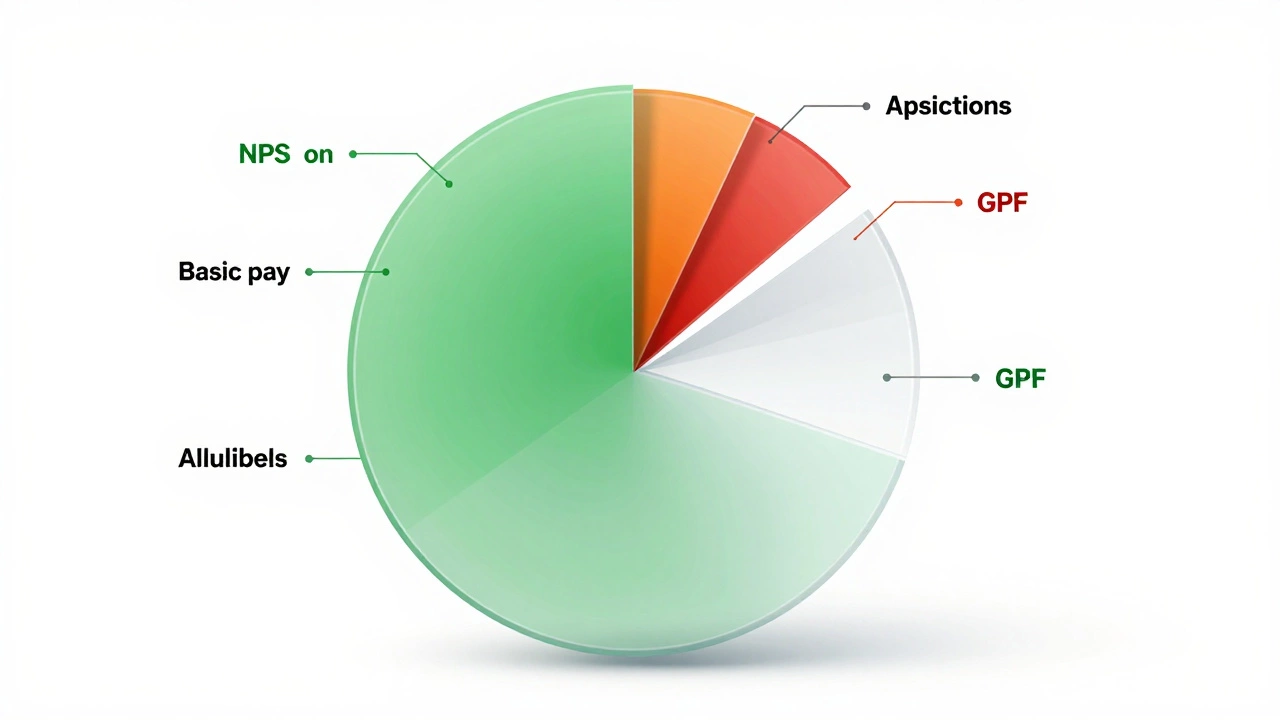
If the gross salary looks okay, why does the net feel so thin? The answer lies in mandatory deductions. Government employees contribute to two major funds: the National Pension System (NPS) and the General Provident Fund (GPF).
- NPS Contribution: You contribute 10% of your basic pay plus DA. The government matches this with 14%. While this builds a retirement corpus, it takes a huge chunk out of your current cash flow.
- GPF Contribution: Another 10% goes here. Unlike NPS, this is essentially your own savings, but it is locked until retirement.
- Income Tax: TDS is deducted automatically based on slabs.
So, before you even spend a rupee, roughly 20-30% of your earnings are diverted to long-term savings or taxes. Compare this to the private sector, where provident fund contributions are often lower (typically 12% total split between employer and employee) and pension schemes are less aggressive. The government prioritizes post-retirement security over current disposable income. This structural choice makes the monthly salary look "low" because a significant portion is being saved for you, whether you want it to be or not.
Job Security vs. High Risk Premium
We need to talk about risk. Private sector jobs offer higher salaries because they charge a "risk premium." If the market crashes, companies lay off staff. If a project fails, bonuses vanish. In contrast, Government Job Security is virtually absolute once you are confirmed. You cannot be fired without due process. You get paid during strikes (in many cases), during medical leave, and during economic downturns.
This stability has a monetary value. Economists often calculate the "present value" of a guaranteed 30-year income stream versus a volatile one. The government salary is priced lower because the volatility is near zero. For someone who values peace of mind over luxury consumption, this trade-off makes sense. For someone chasing quick wealth, it feels like a penalty.
The Power of Perks: What Money Can't Buy
Salaries are only one part of compensation. Government jobs come with perks that are difficult to quantify in dollars but have immense real-world value.
| Component | Private Sector (Mid-Level) | Government (Entry-Level GS) |
|---|---|---|
| Cash Salary | High | Moderate |
| Healthcare | Insurance Cap (often limited) | CGHS (Comprehensive, family-wide) |
| Housing | Rent from pocket | Quarters or high HRA |
| Leave Encashment | Limited or none | Full encashment on retirement |
| Loan Interest | Market rates (8-12%) | Subsidized (4-7%) |
Consider healthcare. A private employee pays premiums and faces co-pays. A government employee gets access to the Central Government Health Scheme (CGHS), which covers almost all medical expenses for the employee and their dependents. Over a lifetime, this saves lakhs of rupees. Then there is housing. Many government offices provide official quarters. Even if you don't live in them, the rent-free accommodation or the high HRA means you aren't spending 30-40% of your income on shelter. Add in subsidized loans for education, home, and vehicles, and the effective purchasing power of a GS salary rises sharply.

The Slow Ladder: Growth and Promotions
In the private sector, if you perform well, you might get a 20-30% hike or a promotion within a year. In the government, growth is rigid. It follows the Pay Matrix Level. You move up one cell every year automatically, regardless of performance. Promotions to higher levels take years. This slow progression frustrates ambitious young professionals. They see peers doubling their salaries while they inch forward by a few thousand rupees annually. This lack of rapid upward mobility contributes to the perception that the salary is "stuck" at a low level.
Is It Still Worth It?
Despite the lower initial cash flow, government jobs remain highly sought after. Why? Because the total cost of living is lower due to perks, and the retirement package is superior. The NPS corpus, combined with GPF and pension (for older recruits) or lump-sum payouts, ensures financial dignity in old age. Private sector workers often face uncertainty after 60. Government workers do not.
If you are preparing for exams, remember that the salary is not just a number. It is a bundle of security, health, housing, and retirement benefits. The "low" salary is the price you pay for a life free from the fear of unemployment. Whether that price is fair depends on your personal definition of success.
What is the exact starting salary for a Group C government employee?
The starting basic pay for most Group C posts is ₹18,000 per month. With Dearness Allowance (DA) and House Rent Allowance (HRA), the in-hand salary typically ranges between ₹30,000 and ₹40,000 depending on the city of posting.
Do government employees get bonuses?
Yes, government employees receive a Performance-Based Incentive (PBI) or bonus, usually equivalent to one month's basic pay plus DA, subject to budget availability and individual performance ratings.
How does NPS affect my monthly salary?
You contribute 10% of your basic pay and DA to NPS. This amount is deducted from your salary every month. While it reduces your immediate take-home pay, it builds a substantial retirement corpus with government matching contributions.
Are government salaries revised regularly?
Basic pay is revised periodically through Pay Commissions (every 10-12 years). However, Dearness Allowance (DA) is revised biannually (June and December) to offset inflation, ensuring your real income doesn't drop due to rising prices.
Can I switch to the private sector after joining a government job?
Yes, but there are restrictions. You may need to serve a minimum tenure (often 2-5 years) before resigning. Additionally, switching later in life can be challenging due to skill gaps, as government roles often involve procedural work rather than dynamic industry skills.