CBSE Syllabus Guide: Is It the Best Choice for Your Child in 2026?
School Board Suitability Checker
Parent & Student Profile
Select the options that best describe your situation.
Based on your inputs, here is the recommendation breakdown.
CBSE
0%Reasoning will appear here.
ICSE
0%Reasoning will appear here.
International (IB/Cambridge)
0%Reasoning will appear here.
State Boards
0%Reasoning will appear here.
Final Recommendation:
Please select your preferences to see a recommendation.
Fill out the profile on the left and click Analyze Best Fit to see which school board suits your child's future in 2026.
Choosing a school board for your child is one of those decisions that feels heavy. You want them to have fun, learn deeply, and stay ahead in a competitive world. In India, the CBSE syllabus often comes up first in conversations. But is it actually the "best"? The short answer is: it depends on where you see your child’s future. If they are aiming for top engineering colleges like IITs or medical seats via NEET, the Central Board of Secondary Education (CBSE) is arguably the strongest foundation. If they are looking for a more holistic, arts-focused, or international path, other boards might serve them better.
In this guide, we break down what makes the CBSE curriculum tick, how it compares to its main rivals, and who should stick with it versus who should look elsewhere. We’ll look at the reality of the classroom experience, not just the brochure promises.
What Exactly Is the CBSE Syllabus?
The Central Board of Secondary Education (CBSE) is the largest school board in India, governing over 30,000 schools across the country and abroad. Established under the Ministry of Education, Government of India, it follows a standardized national curriculum. Unlike state boards, which vary wildly from Kerala to Punjab, CBSE offers consistency. A student moving from Delhi to Mumbai or even to Dubai can switch schools without missing key concepts.
The core philosophy behind the CBSE syllabus is alignment with national competitive exams. The content structure mirrors the questions asked in JEE Main (engineering) and NEET (medical). This isn’t a coincidence; it’s a design feature. The board focuses heavily on science and mathematics, treating them as the pillars of higher education. Arts and commerce streams exist but often receive less emphasis in public perception and sometimes in resource allocation within schools.
Why Parents Call CBSE the "Best" Board
There are specific reasons why CBSE dominates the conversation. Let’s look at the practical advantages that matter to parents planning for 2026 and beyond.
- Competitive Exam Readiness: The depth of Physics, Chemistry, and Biology in CBSE Class 11 and 12 is unmatched by most other Indian boards. If your child dreams of being an engineer or doctor, they won’t need to bridge a massive gap between school knowledge and entrance exam requirements.
- National Consistency: For families who relocate frequently-defense personnel, diplomats, or corporate employees-CBSE is a safe harbor. The syllabus doesn’t change based on state politics or local language preferences.
- Affordability and Accessibility: While elite private schools charge premium fees, many mid-tier and government-aided schools follow CBSE. This makes quality education accessible to a broader economic spectrum compared to international boards like IB or Cambridge.
- Digital Integration: In recent years, CBSE has integrated digital learning tools and competency-based assessments. The introduction of project-based learning in certain subjects aims to move away from pure rote memorization, though implementation varies by school.
The Hidden Costs: Stress and Rote Learning
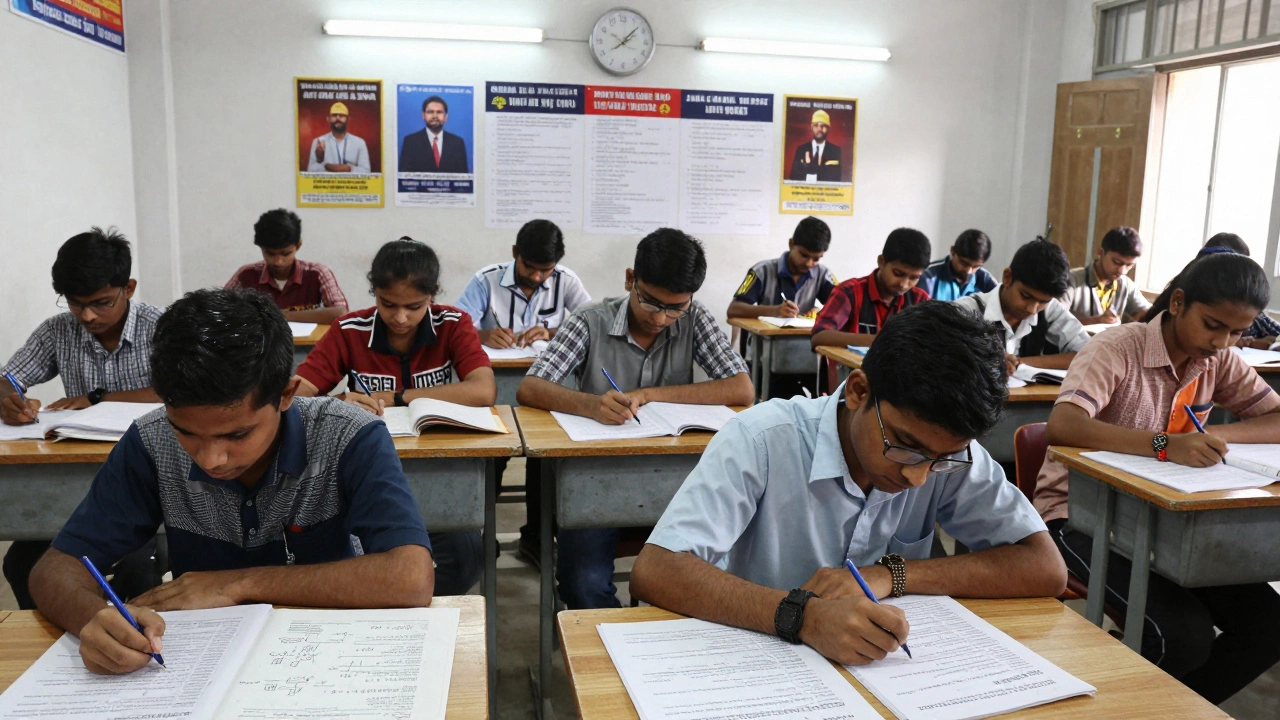
Every system has trade-offs. The biggest criticism of the CBSE syllabus is its rigidity. The pressure to perform well in board exams can be intense. Students often spend their final year revising rather than exploring new ideas. This "exam-oriented" approach can stifle creativity and critical thinking if the school doesn’t actively counterbalance it.
Additionally, the syllabus can feel dry. History, for instance, is often taught as dates and events rather than narratives and analysis. Science experiments are sometimes reduced to writing down expected results rather than actual discovery. If your child thrives on discussion, debate, and open-ended projects, they might find the standard CBSE classroom restrictive.
CBSE vs. ICSE: The Great Indian Debate
You cannot talk about CBSE without mentioning its main rival, the Indian Certificate of Secondary Education (ICSE). Administered by the Council for the Indian School Certificate Examinations, ICSE is known for its detailed syllabus and strong focus on English literature and languages.
| Feature | CBSE | ICSE |
|---|---|---|
| Focus Area | Science & Math (STEM) | Languages, Literature & Holistic Arts |
| Syllabus Depth | Concise, aligned with JEE/NEET | Vast, detailed, requires deep reading |
| English Proficiency | Functional and academic | High emphasis on grammar, vocabulary, and expression |
| Exam Pattern | Objective + Short/Long Answer | Descriptive, essay-based, internal assessments carry significant weight |
| Best For | Engineering/Medical aspirants, frequent movers | Arts/Humanities students, those staying in one region |
If your child loves reading novels, debating, and writing essays, ICSE might keep them more engaged. However, if they are destined for IITs, CBSE gives them a head start. Many students switch from ICSE to CBSE in Class 11 specifically to align with engineering entrance prep.
CBSE vs. State Boards: Why the Difference Matters
State boards are managed by individual states. Their syllabi often include local history, culture, and sometimes regional languages as compulsory subjects. The quality of education can vary significantly. Some state boards, like Maharashtra’s HSC, are quite rigorous, while others may lag in infrastructure and teaching standards.
For parents aiming for national-level recognition or planning to study outside their home state, CBSE provides a recognized benchmark. Admissions committees at top universities across India view CBSE marks with a consistent understanding, whereas state board grading systems can be opaque.
Who Should Choose CBSE in 2026?
Let’s get practical. Here is a quick decision tree to help you decide if the CBSE syllabus is the right fit.
- Choose CBSE if:
- Your child wants to pursue Engineering, Medicine, or Defense services.
- Your family moves frequently due to work.
- You prefer a structured, predictable curriculum.
- You want access to a wide range of schools across India and abroad.
- Consider Alternatives if:
- Your child is passionate about Arts, Humanities, or Creative Writing (look at ICSE or IB).
- You plan to send them to university in the UK, Canada, or Australia early (Cambridge International or IB is often preferred).
- You value continuous assessment and project work over high-stakes final exams (IB excels here).
Recent Changes in the CBSE Curriculum
The CBSE is not static. In response to global educational trends, the board has introduced several changes in recent years that affect the 2026 cohort. The National Education Policy (NEP) 2020 has influenced CBSE to adopt a more flexible structure. There is now greater emphasis on vocational skills, mental health awareness, and coding from middle school levels.
Furthermore, the elimination of the distinction between "core" and "optional" subjects in some stages allows students to mix interests-for example, pairing Computer Science with Psychology. This flexibility is a step toward making the syllabus less rigid and more student-centric.
Final Thoughts on Picking the Right Path
There is no single "best" syllabus. The best syllabus is the one that matches your child’s strengths and your family’s goals. CBSE is a powerhouse for STEM careers and stability. It is robust, widely accepted, and prepares students for the toughest academic battles in India. But it demands discipline and resilience. If you choose CBSE, support your child with resources that encourage curiosity beyond the textbook, so they don’t just become good test-takers, but well-rounded thinkers.
Is CBSE harder than ICSE?
It depends on the subject. CBSE is generally considered harder in Science and Mathematics because it aligns with competitive exams like JEE and NEET. ICSE is often perceived as more challenging in English, Literature, and Languages due to its vast syllabus and emphasis on descriptive answers.
Can I switch from CBSE to another board in Class 11?
Yes, many students switch boards in Class 11. However, switching from CBSE to ICSE or vice versa can be difficult due to differences in syllabus depth. Switching to an international board like IB or Cambridge usually requires additional preparation for language and methodology differences.
Is CBSE recognized internationally?
Yes, CBSE is recognized globally. However, for direct entry into universities in the US, UK, or Canada, students often need to take additional tests like SAT, ACT, or IELTS. International boards like IB or Cambridge A-Levels are sometimes preferred by foreign universities due to their global familiarity.
Does CBSE focus only on Science students?
No, CBSE offers Commerce and Arts/Humanities streams as well. However, the board’s reputation is strongest in Science due to its alignment with engineering and medical entrance exams. Resources and coaching for Commerce and Arts are available but may be less abundant in some regions.
How does the new NEP 2020 affect the CBSE syllabus?
The NEP 2020 encourages multidisciplinary learning. CBSE has responded by allowing more subject combinations, integrating vocational training, and focusing on competency-based learning rather than just rote memorization. This makes the curriculum slightly more flexible than before.