Which Board Is the Toughest in India? CBSE vs ICSE vs State Boards Compared
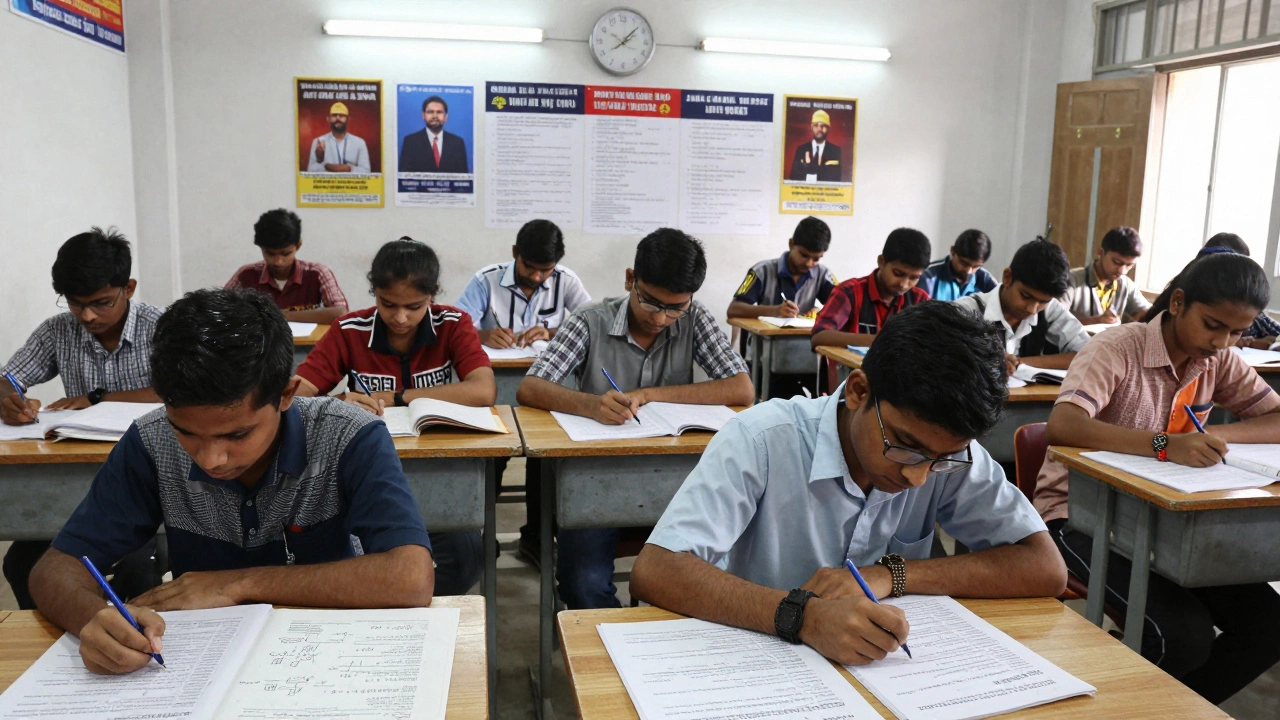
When parents and students in India ask which board is the toughest, they’re not just curious-they’re making a decision that affects years of study, exam stress, and future opportunities. The answer isn’t simple. It depends on what you mean by ‘tough.’ Is it the depth of content? The pressure to score high? The way exams are structured? Or how much it prepares you for competitive exams like JEE or NEET?
Let’s cut through the noise. There’s no single ‘toughest’ board in India. But there is one that stands out for its rigor, breadth, and how it shapes a student’s path: CBSE. Not because it’s the hardest in every subject, but because it’s designed to push students toward national-level competition from day one.
Why CBSE Feels Like the Toughest
CBSE, or the Central Board of Secondary Education, isn’t just another board. It’s the backbone of India’s education system for over 20,000 schools, including all Kendriya Vidyalayas and Jawahar Navodaya Vidyalayas. Its syllabus is standardized across the country, which means students from Tamil Nadu to Jammu can sit for the same national exams. But that uniformity comes with a price.
CBSE’s curriculum is tightly aligned with competitive exams. The physics syllabus in Class 11 doesn’t just teach Newton’s laws-it builds toward JEE Main problems. The chemistry chapters in Class 12 don’t stop at memorizing reactions-they dive into reaction mechanisms that appear in NEET. Even English isn’t just about grammar; it’s about analytical writing, comprehension, and critical thinking that mirror the pattern of civil services and engineering entrance tests.
Here’s the real difference: CBSE doesn’t just test knowledge. It tests speed, accuracy, and application under pressure. The board exams are designed to filter. A 90% score in CBSE is harder to get than in many state boards because the marking is strict, the questions are application-based, and the syllabus doesn’t let you skip tough topics.
How ICSE Compares
ICSE, the Indian Certificate of Secondary Education, is often called the ‘more balanced’ board. It covers more topics in greater detail. In history, ICSE students study medieval Indian architecture, colonial economic policies, and global trade routes-all in one year. In science, they get deeper into lab work and project-based learning. Their English papers demand essays with literary analysis, not just summaries.
But here’s the catch: ICSE doesn’t prepare you for JEE or NEET the same way CBSE does. The syllabus is broader, not deeper in the way competitive exams require. A student switching from ICSE to JEE coaching often spends six months catching up on physics formulas and math shortcuts that CBSE students learned in Class 9.
So is ICSE tougher? Yes-if you measure it by volume of content. No-if you measure it by exam pressure. ICSE students get more time to write, more open-ended questions, and less emphasis on rote memorization. CBSE? You get 3 hours to solve 70 questions. No time to second-guess.
State Boards: The Wild Card
State boards like Maharashtra, Uttar Pradesh, or West Bengal vary wildly. Some, like Maharashtra’s SSC, have a reputation for being easier. Their papers are more direct, with more definition-based questions. Others, like Tamil Nadu’s State Board, have a strong focus on regional language and local history, which can be challenging for non-native speakers.
But here’s what no one talks about: state boards are often the path of least resistance for students aiming for local colleges. If you’re not planning to take JEE, NEET, or UPSC, a state board can be perfectly fine-sometimes even better. The syllabus is smaller, the pressure is lower, and the grading is more lenient.
But if you’re aiming for IITs, AIIMS, or top private universities? CBSE is the default. Most coaching centers in Kota, Delhi, or Hyderabad design their material around CBSE’s syllabus. Why? Because that’s what 80% of the top rankers come from.
The Hidden Pressure: How CBSE Shapes Mindsets
It’s not just about the syllabus. It’s about the culture.
CBSE schools often have a high-performance environment. Teachers expect you to solve problems before class. Parents expect 90+ marks. Schools track your performance in weekly tests, not just annual exams. The pressure to perform isn’t just external-it becomes internal.
Compare that to a state board school where a 75% is considered excellent. Or an ICSE school where creativity matters more than speed. In CBSE, you learn early that one mistake in math can cost you a rank. One misread question in chemistry can drop you 20 places.
That’s why CBSE feels toughest-not because the topics are harder, but because the stakes are higher from the start.
What the Data Shows
Let’s look at numbers from the last three years:
- Over 72% of IIT JEE qualifiers in 2024 came from CBSE schools.
- ICSE students made up only 8% of JEE top 1000, despite having higher average scores in school exams.
- For NEET, 78% of top scorers were from CBSE, with most from schools in Delhi, Haryana, and Uttar Pradesh.
- State board students account for 15-20% of NEET qualifiers-but mostly from states with high population density, like Bihar and MP.
The pattern is clear: CBSE doesn’t just teach the syllabus-it trains you for the battlefield.
Is CBSE the Right Choice for Everyone?
No.
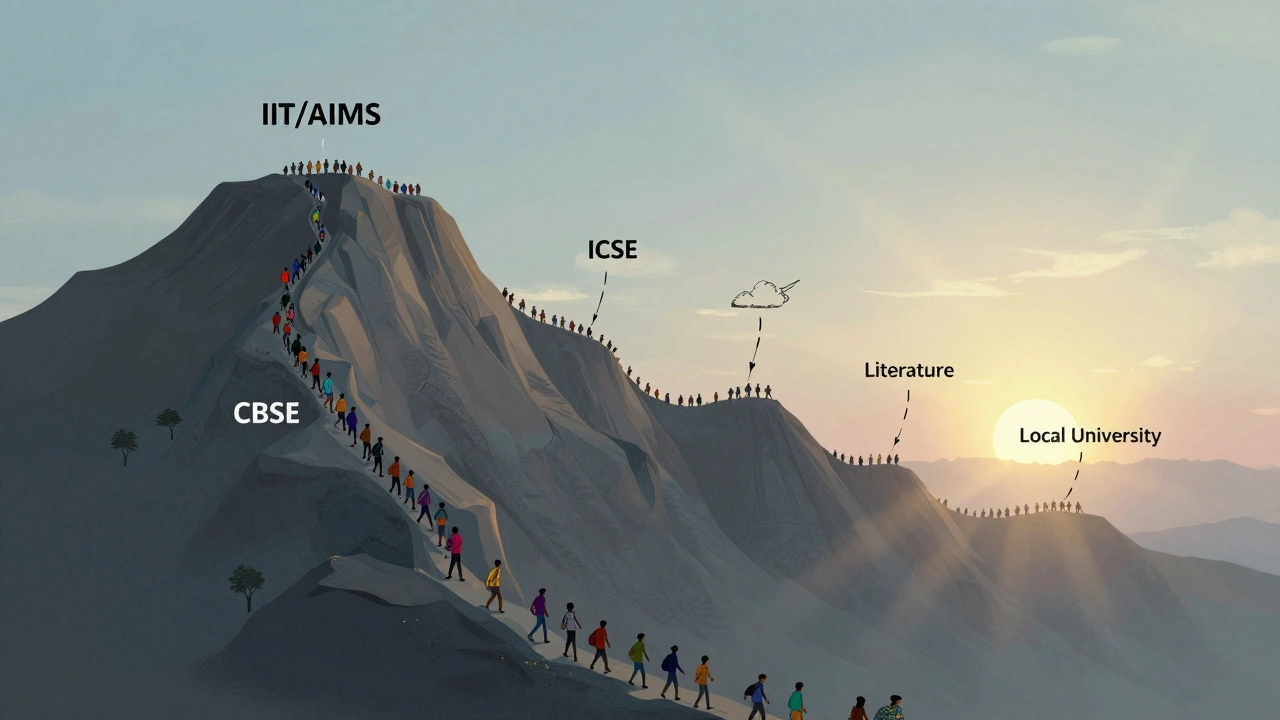
If you’re not planning to take engineering or medical entrance exams, CBSE’s intensity can be overwhelming. Its rigid structure leaves little room for exploration. Students who thrive on project-based learning, creative writing, or interdisciplinary studies often feel stifled.
ICSE might be better for students who want to study literature, fine arts, or international curricula. State boards are ideal for those who plan to attend state universities, join local government jobs, or pursue vocational paths.
But if your goal is to crack JEE, NEET, UPSC, or get into a top private university like Ashoka, FLAME, or Symbiosis? CBSE gives you the most direct route.
What Parents Should Know
Many parents choose CBSE because ‘it’s the most recognized.’ That’s true-but it’s not the whole story.
The real question isn’t ‘Which board is toughest?’ It’s ‘Which board aligns with your child’s goals?’
Here’s a simple rule:
- If your child wants to become an engineer, doctor, or civil servant → CBSE.
- If your child loves writing, art, or global studies → ICSE.
- If your child plans to stay in your state for college and careers → state board.
There’s no shame in choosing easier. But if you’re aiming for the top 1%, CBSE is the only board that prepares you for that race from Class 6.
Final Thought: Toughness Is Contextual
The toughest board isn’t the one with the hardest syllabus. It’s the one that forces you to perform under pressure, think quickly, and adapt to high-stakes exams year after year. That’s CBSE.
But toughness doesn’t mean superiority. It means alignment. And for millions of Indian students, CBSE isn’t just a board-it’s a training ground for the country’s most competitive exams.
Is CBSE harder than ICSE for Class 10?
Yes, for most students. CBSE Class 10 exams are more application-based and time-pressured. ICSE has more questions and broader topics, but gives more time to write. CBSE’s marking is stricter, and scoring above 90% is harder. However, ICSE demands deeper understanding of concepts, especially in English and science.
Do state boards prepare students for JEE and NEET?
Not directly. State board syllabi are often narrower and less aligned with JEE/NEET patterns. Students from state boards usually need 6-12 months of extra coaching to bridge the gap in topics like calculus, organic chemistry, and modern physics. CBSE students start from a much closer baseline.
Can I switch from ICSE to CBSE in Class 11?
Yes, but it’s challenging. ICSE students often miss out on key JEE/NEET topics covered in Class 9 and 10 under CBSE, like coordinate geometry, chemical bonding, and motion graphs. You’ll need intensive self-study or coaching to catch up. Many students who switch struggle in the first year.
Why do so many coaching centers use CBSE syllabus?
Because CBSE is the most widely followed board in India, and its syllabus directly maps to JEE and NEET. Coaching institutes design their modules around CBSE’s structure because it covers 90% of the topics tested in entrance exams. Using any other board as a base would require major redesigns.
Is CBSE better for international universities?
It’s acceptable, but not ideal. International universities prefer IB or Cambridge A-Levels because they’re globally standardized. CBSE is recognized, especially in the US and UK, but students often need to take SAT/ACT and IELTS/TOEFL to compensate. ICSE is slightly better for international applications due to its emphasis on English and project work.