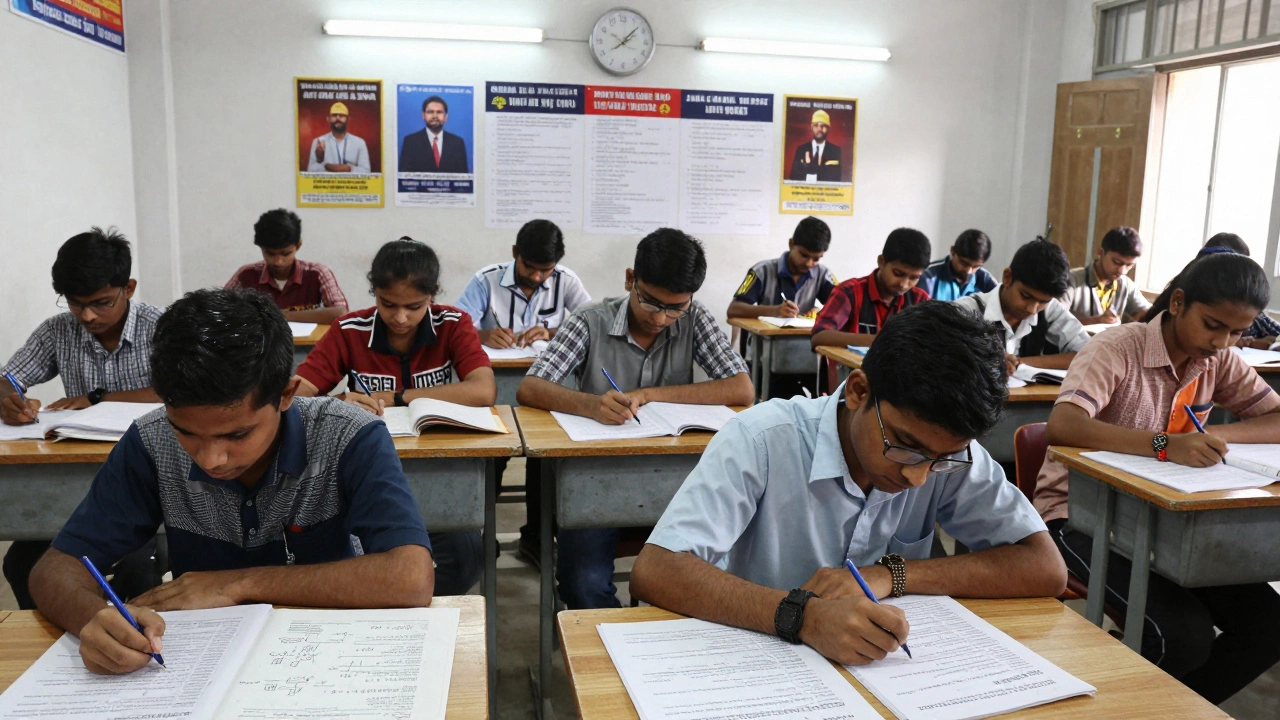
Why is CBSE preferred by Indian families for school education?

CBSE vs State Board Decision Calculator
Which Education Board is Best for Your Child?
Answer these questions to see how CBSE compares to state boards for your family's needs.
CBSE is likely the better choice for your family if you need:
- Seamless transitions between schools
- Preparation for national exams like JEE and NEET
- International education opportunities
- Consistent quality across schools nationwide
State Board may be better for your family if you need:
- Strong focus on regional culture and language
- More hands-on, project-based learning
- Less emphasis on national exams
- Localized education tailored to your region
Every year, millions of Indian parents choose CBSE for their children’s schooling-not because it’s the only option, but because it works. If you’ve ever sat in a parent-teacher meeting wondering why everyone’s talking about CBSE, you’re not alone. The answer isn’t about prestige. It’s about practicality, consistency, and long-term planning.
CBSE syllabus is designed for national mobility
Families move. A lot. A father gets transferred to a new city. A mother takes a job in another state. When that happens, switching schools shouldn’t mean restarting the entire curriculum. CBSE solves this. Whether your child is in Delhi, Kochi, or Chandigarh, the syllabus, textbooks, and exam pattern stay the same. That’s not true for most state boards. In Tamil Nadu, for example, science topics might be taught in a different order, or even left out entirely. CBSE ensures continuity. No gaps. No catching up. Just seamless learning.It aligns with national competitive exams
Think about the big ones: JEE, NEET, CUET, NDA. These exams don’t follow state board patterns. They follow CBSE’s structure. The way physics problems are framed in JEE? That’s CBSE-style. The biology chapters tested in NEET? They match CBSE’s Class 11 and 12 syllabus word-for-word. State board students often spend their Class 11 and 12 years relearning concepts because their curriculum doesn’t cover depth or application the way these exams demand. CBSE students don’t. They’re already trained to think in terms of concepts, not memorization. That’s why over 85% of JEE qualifiers come from CBSE or ICSE schools, according to data from the National Testing Agency.Focus on application, not rote learning
CBSE doesn’t just ask you to recall facts. It asks you to explain, analyze, and solve. A Class 10 math question might give you a real-life scenario-like calculating fuel efficiency for a delivery truck-and ask you to build an equation. A Class 12 chemistry paper doesn’t just test names of compounds; it asks you to predict reaction outcomes based on functional groups. This isn’t accidental. CBSE revised its syllabus in 2020 to reduce content load and increase critical thinking. The board now recommends 30% of exam questions be application-based. That’s a deliberate shift. State boards, especially in smaller states, still rely heavily on direct questions from textbooks. CBSE prepares students for the real world, not just the classroom.Teachers are trained for uniform standards
CBSE doesn’t just set the syllabus-it trains the teachers. Every year, thousands of CBSE-affiliated teachers attend workshops conducted by the board itself. These aren’t marketing events. They’re deep-dive sessions on new pedagogical methods, updated exam patterns, and student assessment techniques. A teacher in rural Rajasthan learns the same evaluation rubric as a teacher in Mumbai. That consistency means a student’s performance is measured by the same standard, no matter where they sit for the exam. State boards often leave teacher training to district education departments, which vary wildly in quality. That leads to uneven outcomes.
CBSE is the gateway to higher education and global opportunities
Universities abroad recognize CBSE. Not because it’s Indian, but because it’s predictable. The grading system, the subject structure, the way subjects are grouped-these are all familiar to international admissions officers. CBSE issues a detailed marksheet with subject-wise grades and a statement of marks that clearly shows course content. Many U.S. and U.K. universities have direct equivalence guidelines for CBSE Class 12 results. That’s not true for most state boards. A student from Uttar Pradesh might struggle to explain what their board covered in biology because their transcript doesn’t list topics. CBSE makes translation easy.It’s built for digital learning
CBSE launched its own digital platform, DIKSHA, in 2019. It’s not just a repository of PDFs. It’s a full ecosystem: video lessons, interactive quizzes, practice tests, and teacher resources-all aligned with the syllabus. When schools shut down during the pandemic, CBSE students didn’t fall behind. They kept going. Why? Because their learning infrastructure was already digital. State boards mostly relied on printed worksheets or WhatsApp groups. CBSE’s system scales. It works for a student in a village with a smartphone and a student in a metro with a laptop. That’s why 92% of CBSE schools now use some form of digital learning tools, compared to just 47% of state board schools, according to a 2024 NCERT survey.Parents trust it because it’s transparent
CBSE publishes its entire syllabus online, with clear chapter-wise weightage, marking schemes, and sample papers. You can download them. You can print them. You can compare them year after year. There’s no mystery. No last-minute changes. No hidden topics. Compare that to some state boards that change syllabi mid-year or don’t release official sample papers until a month before exams. Parents don’t like surprises. They want to plan. CBSE gives them the tools to do that.It’s not perfect-but it’s the most reliable
Yes, CBSE has its critics. Some say it’s too rigid. Others say the pressure is too high. But when you look at outcomes-pass rates, college admissions, competitive exam success, international recognition-it’s hard to ignore. CBSE isn’t the easiest path. It’s the most dependable one. For families who want their child to have options-whether that’s an IIT, a medical college, a university in Canada, or a startup in Bengaluru-CBSE gives them the foundation. It doesn’t promise genius. It promises preparedness.
What CBSE doesn’t do well
It’s fair to say CBSE isn’t perfect. It doesn’t emphasize regional languages as much as state boards. It doesn’t always reflect local culture in its literature or social science modules. It can feel impersonal to students who thrive in project-based, hands-on learning. But for the majority of Indian families-those who move, those who aim for national exams, those who want their child to compete on a national scale-these trade-offs are worth it.| Feature | CBSE | UP Board | Maharashtra Board | Tamil Nadu Board |
|---|---|---|---|---|
| Syllabus Uniformity Across States | Yes | No | No | No |
| Alignment with JEE/NEET | High | Low | Moderate | Low |
| Application-Based Questions | 30%+ | 10-15% | 20% | 10% |
| Digital Learning Support | Yes (DIKSHA) | Minimal | Partial | Minimal |
| Recognition by Foreign Universities | Widely Accepted | Often Requires Evaluation | Some Acceptance | Limited |
| Teacher Training Standardization | Centralized | Decentralized | Decentralized | Decentralized |
Who should choose CBSE?
If your family moves often, CBSE is the safest bet. If your child might take JEE, NEET, or CUET, CBSE gives them a head start. If you want your child to study abroad later, CBSE makes the transition smoother. If you value clear syllabi, digital resources, and consistent teaching standards, CBSE delivers.Who might want to look elsewhere?
If your child thrives in a localized, culturally rooted curriculum-like learning Marathi poetry in depth, or studying regional history in detail-then a state board might be a better fit. If you live in a small town with no access to CBSE-affiliated schools, practicality overrides preference. If your child learns best through hands-on projects and your local board offers more arts, crafts, or vocational integration, then that’s a valid choice too. But if you’re aiming for national-level opportunities, CBSE is the most common path for a reason.Is CBSE easier than state boards?
No, CBSE is not easier. It’s more structured. State boards often have more content to memorize, while CBSE focuses on understanding concepts deeply. CBSE exams test application, not just recall. Many students find it harder because they’re asked to solve unfamiliar problems. But the clarity of the syllabus and exam pattern makes preparation more predictable.
Can CBSE students switch to state boards later?
Yes, but it’s disruptive. CBSE’s Class 11 and 12 syllabus doesn’t fully overlap with most state boards. A student switching from CBSE to Maharashtra Board in Class 11 will likely miss key topics in physics and chemistry. They’ll need to catch up on their own. It’s possible, but not recommended unless there’s a strong personal or geographic reason.
Does CBSE help with international admissions?
Yes. Universities in the U.S., U.K., Australia, and Canada have established evaluation systems for CBSE Class 12 results. Their admissions teams know what the syllabus covers. A CBSE transcript with subject-wise grades and a detailed marksheet gives them confidence in the student’s academic background. State board transcripts often lack this detail, requiring extra verification.
Is CBSE only good for science students?
No. CBSE offers strong streams in commerce and humanities too. The Class 12 economics, business studies, and accountancy syllabi are designed to align with university-level courses. Even in history and political science, the focus is on analysis, not just dates. Many students from CBSE schools get into top liberal arts colleges abroad because their critical thinking skills are already developed.
How often does CBSE change its syllabus?
CBSE reviews its syllabus every 3 to 5 years. Major changes happen after national education policy updates, like the 2020 NEP. Minor updates-like removing outdated topics or adding current events-are released annually. The board publishes these changes well in advance, so schools and students have time to adjust. This predictability is one reason parents trust it.