Does an MBA Increase Salary? The Real Numbers Behind the Degree

MBA ROI & Salary Break-Even Calculator
Your Financial Profile
Projected Outcomes
Enter Data- Opportunity Cost (Lost Wages) $0
- Total Direct Costs $0
- Total Investment $0
Time to recoup total investment via salary differential.
Key Takeaways
- An MBA from a top-tier program typically yields a salary jump of 30% to 100% immediately after graduation.
- The return on investment (ROI) depends heavily on the prestige of the school and your pre-MBA experience.
- Mid-career professionals often see higher lifetime earnings than those who pursue an MBA early in their careers.
- Networking and access to exclusive recruitment pipelines are often more valuable than the curriculum itself.
- Not all MBAs guarantee a raise; lower-ranked programs may result in a net loss when tuition and opportunity costs are factored in.
You spend two years away from the workforce. You pay tuition that can range from $50,000 to over $200,000. You trade your current paycheck for student loans. So, does it actually pay off? If you are sitting there wondering if MBA salary increase is real or just marketing hype, you aren't alone. It is one of the most debated questions in professional development right now.
The short answer is yes, but with a massive asterisk. An MBA doesn't automatically inflate your paycheck like a magic button. Instead, it acts as a lever. It amplifies your existing value, opens doors that were previously locked, and repositions you in the job market. However, if you pull that lever without the right foundation-like work experience or a strong academic record-you might end up with debt and no significant financial gain.
How Much Does an MBA Actually Raise Your Income?
To understand the numbers, we have to look at data from reputable sources like the Financial Times Global MBA Ranking and the Poets&Quants reports. These rankings track graduate employment outcomes meticulously. The reality is starkly divided by school tier.
For graduates from top-10 global programs (think Harvard Business School, Stanford Graduate School of Business, or INSEAD), the median base salary often lands between $150,000 and $170,000 USD. For many students coming from these programs, this represents a doubling or even tripling of their pre-MBA income. A consultant making $80,000 before school might step into a role paying $160,000 plus bonuses post-graduation.
However, the picture changes dramatically for mid-tier or regional schools. Here, the median starting salary might hover around $90,000 to $110,000 USD. If you were already earning $85,000, the jump is modest. When you factor in the cost of tuition, living expenses, and the two years of lost wages (opportunity cost), the break-even point stretches out significantly. Some students from lower-ranked programs take five to seven years just to recoup their investment through salary differentials.
| School Tier | Avg. Pre-MBA Salary | Avg. Post-MBA Salary | Typical ROI Timeline |
|---|---|---|---|
| Top 10 Global | $80k - $100k | $150k - $170k+ | 1 - 3 Years |
| Top 20-40 | $70k - $90k | $110k - $130k | 3 - 5 Years |
| Regional/Lower Tier | $60k - $80k | $80k - $100k | 5+ Years (or negative) |
The Hidden Currency: Networking and Access
If you think the degree itself is what buys you the raise, you are missing half the equation. Employers don't pay for the diploma; they pay for the network attached to it. An MBA from a prestigious institution grants you access to a closed ecosystem of alumni, recruiters, and industry leaders.
Consider the concept of "signaling." In economics, signaling theory suggests that credentials act as proof of ability. A degree from a rigorous program signals to employers that you can handle high-pressure environments, complex problem-solving, and strategic thinking. But beyond signaling, there is the pipeline effect. Top consulting firms like McKinsey, Bain, and BCG, as well as major investment banks like Goldman Sachs, recruit almost exclusively from a small list of target schools. Without the MBA from one of these targets, you literally cannot apply for many of the highest-paying entry-level roles in finance and strategy.
This access is invaluable. You aren't just applying to jobs online; you are walking into career fairs where recruiters are desperate to fill quotas. This reduces friction in the job search and allows you to negotiate from a position of strength. Many graduates report that their first post-MBA offer came not from a job board, but from a casual conversation with an alumnus at a networking event.

Industry Matters More Than You Think
Your post-MBA salary isn't determined solely by the school name. It is deeply tied to the industry you choose to enter. Not all sectors reward the same level of premium for an MBA.
Investment Banking is a sector known for offering the highest starting salaries to MBA graduates, often exceeding $150,000 in base pay plus significant bonuses. Similarly, private equity and hedge funds offer lucrative packages, though these roles are notoriously competitive and often require prior experience in banking. Management consulting follows closely behind, offering robust compensation and rapid career progression.
On the other hand, industries like non-profit management, education, or traditional retail operations may not offer the same immediate financial spike. If your goal is purely monetary, targeting high-finance or tech leadership tracks is essential. Tech companies, particularly FAANG firms (Facebook, Amazon, Apple, Netflix, Google), have increasingly become major hirers of MBAs for product management and corporate strategy roles, offering total compensation packages that rival Wall Street.
Opportunity Cost: The Silent Wealth Killer
When calculating whether an MBA increases your salary, most people forget to account for opportunity cost. This is the money you *don't* earn while you are studying. Let's run a simple scenario.
Imagine you are earning $90,000 a year. You decide to go to business school for two years. During that time, you earn zero salary. That is $180,000 in lost wages. Add another $150,000 in tuition and living expenses. Your total investment is $330,000. Now, let's say you graduate and land a job paying $130,000. On paper, your salary increased by $40,000. But compared to your previous trajectory, you are actually behind. It will take you nearly a decade just to catch up to where you would have been financially had you stayed in your job and received standard raises.
This is why the timing of your MBA matters. Professionals who wait until they have 4-6 years of experience tend to see better returns. They enter the program with higher pre-MBA salaries, which means their opportunity cost is higher, but their post-MBA starting salaries are also significantly higher because they bring more practical experience to the table. Early-career MBAs (with less than 3 years of experience) often struggle to command the same premiums because they lack the operational context that employers value.
Executive MBAs vs. Traditional Full-Time Programs
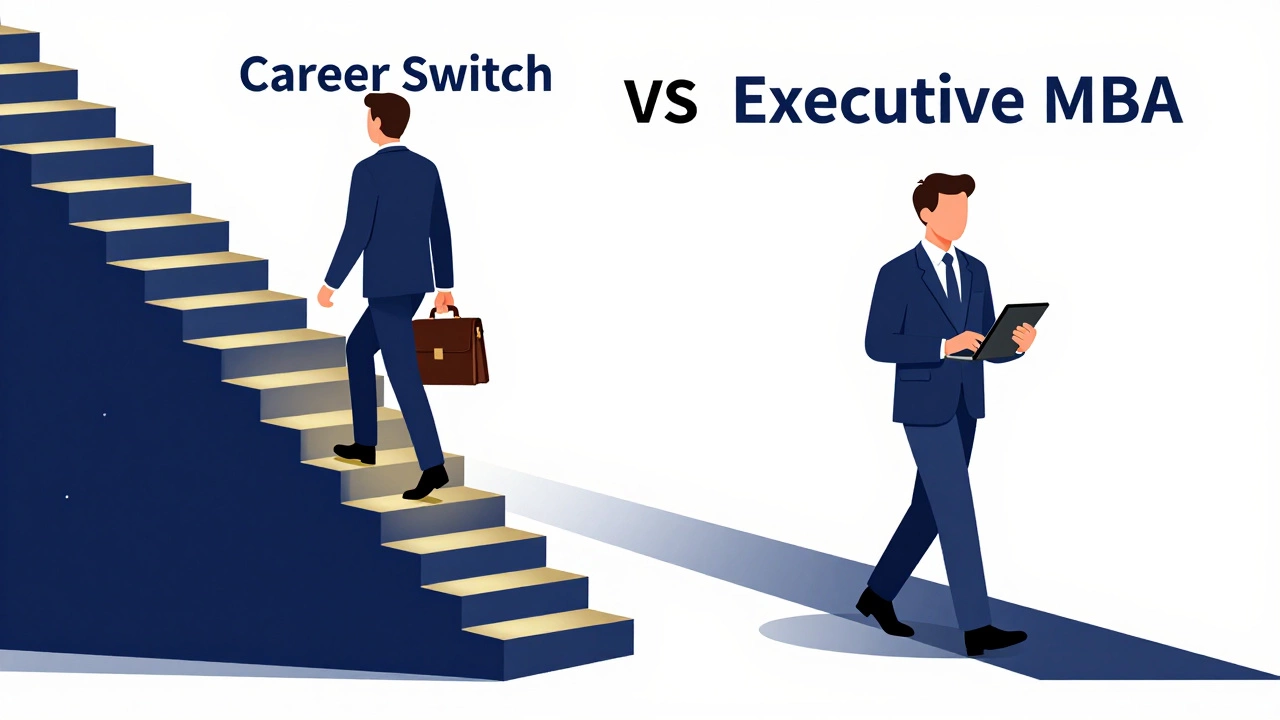
Another variable in the salary equation is the type of MBA you pursue. Executive MBAs (EMBA) are designed for senior leaders who continue working while studying. Because EMBA students do not leave their jobs, they avoid the opportunity cost entirely. Their salary increase comes from accelerated promotions within their current organization rather than a lateral move to a new company.
Traditional full-time MBAs are ideal for career switchers. If you want to move from engineering to finance, or from marketing to strategy, a full-time program provides the structured environment and recruitment support needed to make that pivot. The salary jump here is often larger initially because you are entering a new, higher-paying field. However, EMBA graduates often surpass full-time MBA peers in long-term earnings because they maintain their career momentum and leverage their existing seniority.
When an MBA Might Not Be Worth It
Despite the potential for higher earnings, an MBA is not a universal key to wealth. There are scenarios where the degree fails to deliver a salary boost:
- Low-Ranked Schools: If the program lacks strong employer connections, recruiters won't prioritize your resume. The brand value is negligible.
- No Career Goal: If you go to business school without a clear industry target, you risk graduating with general knowledge but no specific skill set that commands a premium.
- Economic Downturns: Hiring freezes in high-paying sectors like finance and consulting can delay entry-level opportunities, pushing back your ROI timeline.
- Alternative Paths: In some fields, like software engineering or specialized healthcare, gaining technical certifications or advanced degrees (like an MD or PhD) offers a faster and more reliable path to higher income than a generalist MBA.
Ultimately, the question isn't just "does an MBA increase salary?" It is "does this specific MBA increase my salary enough to justify the cost?" You need to treat your education as an investment portfolio. Do your due diligence. Look at the employment reports of the schools you are considering. Talk to alumni. Calculate your break-even point. Only then can you determine if the degree is a stepping stone or a financial burden.
What is the average salary increase after getting an MBA?
The average salary increase varies widely by school tier. Graduates from top-10 global programs often see a 50% to 100% increase in base salary immediately after graduation. For mid-tier schools, the increase is typically 20% to 30%. Lower-ranked programs may offer minimal salary bumps, sometimes failing to cover the cost of the degree within a reasonable timeframe.
Is an MBA worth it if I already have a high salary?
If you already earn a high salary, the opportunity cost of leaving the workforce for two years is significant. In this case, an Executive MBA (EMBA) might be a better option, allowing you to continue earning while advancing your skills. Alternatively, consider if the MBA will help you break through a ceiling into C-suite roles, where the long-term earnings potential justifies the short-term loss.
Which industries pay the most to MBA graduates?
Investment banking, private equity, and management consulting traditionally offer the highest starting salaries for MBA graduates, often exceeding $150,000 in total compensation. Technology companies, particularly in product management and corporate strategy roles, are also becoming major employers with competitive pay packages.
How long does it take to recoup the cost of an MBA?
For graduates from top-tier programs, the break-even period is typically 1 to 3 years post-graduation due to high starting salaries. For mid-tier programs, it may take 3 to 5 years. For lower-ranked programs, it can take 5 years or more, and in some cases, the degree may never fully recoup its cost if the salary bump is marginal.
Do online MBAs lead to the same salary increases as on-campus programs?
Online MBAs from reputable institutions can lead to similar salary increases, especially if the brand recognition is strong. However, they often lack the intensive networking and on-campus recruitment resources that drive immediate job placement in high-paying roles. Success with an online MBA usually depends more on your existing professional network and self-driven career moves.