How Beginners Start Speaking English: A Practical Guide

English Speaking Practice Generator
Select a category below to generate a common phrase used in everyday conversation. Remember: The goal is to be understood, not perfect.
Click a button above to start practicing.
You know the words. You can read a menu in Sydney or understand a Netflix show with subtitles. But when you try to order coffee or ask for directions, your brain freezes. Sound familiar? This is the classic "silent period" trap where learners know more than they can say. The gap between passive knowledge and active speech isn't about intelligence; it's about muscle memory and confidence. Starting to speak doesn't require perfect grammar. It requires breaking the fear barrier and building small, consistent habits that turn thoughts into sounds.
English speaking is the active production of spoken English through vocalization, requiring coordination of cognitive processing, motor skills, and social interaction. Unlike reading or writing, which allow time for correction, speaking demands real-time retrieval and articulation. For beginners, this process often feels overwhelming because it combines linguistic accuracy with psychological vulnerability. However, research from second language acquisition suggests that fluency develops through meaningful interaction rather than isolated memorization.
The Fear Barrier and Why It Stops You
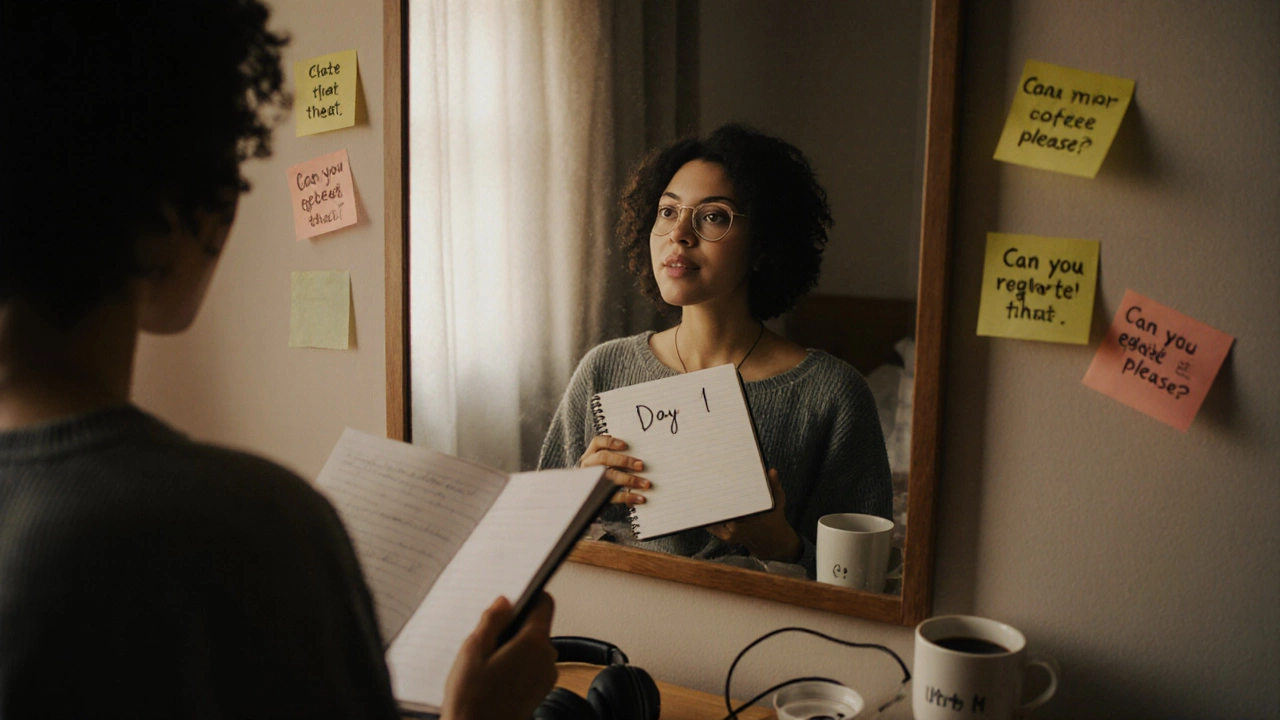
Most beginners don't stop speaking because they lack vocabulary. They stop because they are afraid of making mistakes. This anxiety triggers a stress response that actually blocks access to the language centers of your brain. You might know the word "appointment," but under pressure, your mind goes blank. To fix this, you need to lower the stakes. Stop trying to be perfect. Aim for being understood. If you say "I go yesterday store" instead of "I went to the store yesterday," people still understand you. Communication worked. That is the only metric that matters at the start.
Think of it like learning to drive. You wouldn't wait until you could parallel park perfectly before driving on an empty street. You get behind the wheel, stall the engine, laugh, and try again. Speaking English works the same way. Every mistake is data. It tells you what you don't know yet. Embrace the awkwardness. It’s temporary.
Start With Shadowing: Copy Like a Parrot
If talking to strangers feels too scary right now, start by talking to yourself. One of the most effective techniques for beginners is shadowing, which is a technique where learners listen to native audio and repeat it immediately, mimicking rhythm, intonation, and speed. You don't need a partner. You just need headphones and ten minutes a day.
Here is how to do it properly:
- Pick a short audio clip (1-2 minutes) from a podcast, YouTube video, or audiobook with clear pronunciation.
- Listen once without pausing to get the gist.
- Play the first sentence and pause. Repeat it exactly as you heard it. Copy the emotion, the pauses, even the breaths.
- Move to the next sentence. Do not translate in your head. Just copy the sound.
- Finally, try to speak along with the audio simultaneously.
This trains your mouth muscles to produce English sounds correctly. It also helps your brain internalize natural sentence structures without worrying about grammar rules. Many successful learners in Australia use podcasts like "6 Minute English" by the BBC or local ABC Radio segments for this purpose because the speakers articulate clearly.
Build Your Core Vocabulary First
Beginners often make the mistake of trying to learn rare words like "ubiquitous" or "serendipity." Skip them. Focus on high-frequency words that appear in everyday conversations. Linguists estimate that knowing the top 1,000 most common English words allows you to understand about 85% of daily conversations. That is your target zone.
Don't just memorize lists. Learn phrases. Knowing the word "time" is less useful than knowing "What time is it?" or "It's about time." Phrases give you ready-made chunks of language that you can deploy instantly. This reduces the cognitive load during conversation because you aren't building sentences word-by-word; you are assembling pre-built blocks.
| Category | Purpose | Example Phrases |
|---|---|---|
| Greetings & Small Talk | Breaking the ice safely | "How's it going?", "Nice weather today," "Long time no see" |
| Clarification | Buying time and checking understanding | "Could you repeat that?", "What does X mean?", "Sorry, I didn't catch that" |
| Opinions | Expressing simple views | "I think...", "In my experience...", "I prefer..." |
| Connectors | Making speech flow smoothly | "And then...", "Because...", "So, basically..." |

Create Low-Stakes Practice Environments
You don't need to hire an expensive tutor immediately. Look for low-pressure environments where communication is the goal, not perfection. In cities like Sydney, community libraries often host "English Conversation Clubs." These are usually free or very cheap. The participants are mostly other learners, so everyone is in the same boat. No one judges your accent.
Another option is online language exchange apps. Platforms like Tandem or HelloTalk connect you with native speakers who want to learn your language. You help them with your native tongue; they help you with English. This reciprocal arrangement removes the feeling of being a burden. Plus, text-based chat is a great bridge. Type first, then move to voice notes, and finally, live calls. Each step increases difficulty gradually.
If you prefer structure, look for ESL courses that focus on communicative language teaching rather than traditional grammar-translation methods. Avoid classes that spend three hours lecturing on verb conjugations. You want classes where you are talking for at least 70% of the session.
Record Yourself and Listen Back
This sounds uncomfortable, but it is crucial. We rarely hear our own voices accurately because we hear them through bone conduction. Recording yourself reveals actual pronunciation issues. Use the voice memo app on your phone. Record yourself answering a simple question like "Tell me about your weekend." Keep it under one minute.
Listen back. Don't critique your grammar yet. Listen for clarity. Did you swallow endings? Was your pace too fast? Compare your recording to a native speaker saying similar things. Notice the difference in rhythm. English is a stress-timed language, meaning some syllables are longer and louder than others. If you speak each syllable with equal weight, you will sound robotic. Shadowing helps fix this, but self-recording highlights where you drift off track.

Consistency Beats Intensity
Studying for five hours once a week is less effective than studying for twenty minutes every day. Language acquisition relies on neural pathways strengthening through repetition. Short, frequent bursts keep the language fresh in your working memory. Set a timer. Ten minutes of shadowing in the morning, five minutes of thinking in English while cooking dinner, and five minutes of journaling out loud before bed.
Tie your practice to existing habits. This is called habit stacking. After you brush your teeth, describe your outfit in English. While waiting for the kettle to boil, name five objects in the kitchen. These micro-practices accumulate over months into significant fluency gains.
Frequently Asked Questions
Do I need to know grammar rules before I start speaking?
No. In fact, focusing too much on grammar early on can hinder fluency. Children speak for years before they understand formal grammar rules. As a beginner, prioritize communication over correctness. You will naturally pick up grammar patterns through exposure and feedback as you speak more.
How long does it take to become conversational in English?
For basic conversational ability, most learners achieve this within 3 to 6 months of consistent daily practice (30-60 minutes). Reaching advanced fluency typically takes several years. The timeline depends heavily on the intensity of practice and opportunities for real-world interaction.
Is it better to practice with a native speaker or another learner?
Both have benefits. Native speakers provide authentic pronunciation and slang but may speak too fast. Other learners offer a safer, slower environment where you feel less judged. Ideally, mix both. Use learner groups for confidence-building and native speakers for challenging your listening skills.
What if I forget a word during a conversation?
Use circumlocution. Describe the word instead of translating it. For example, if you forget "umbrella," say "the thing you hold to stop rain." This keeps the conversation flowing and demonstrates communication competence, which is more impressive than pausing silently.
Should I worry about my accent?
Not initially. An accent shows where you come from and is part of your identity. Only focus on accent reduction if it impedes understanding. Clear pronunciation is the goal, not sounding like a news anchor from London or New York.
Next Steps for Your Journey
Start today. Pick one technique-shadowing or phrase memorization-and do it for ten minutes. Then, find one opportunity to speak. Ask a shopkeeper how their day is going. Call a friend and tell them about your day in English. Do not wait for the "right moment." The right moment is whenever you decide to open your mouth. Mistakes are inevitable, but silence is optional. Break the silence, and the rest follows.