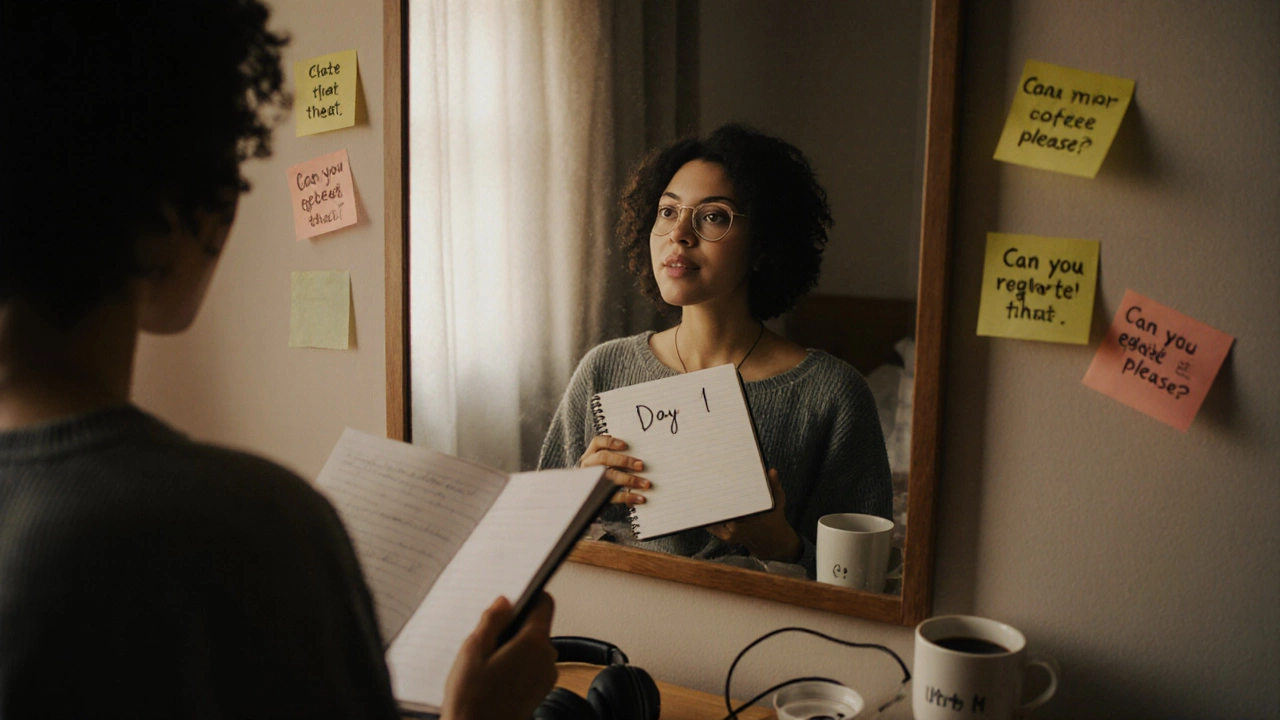
How to Improve Your English Speaking Skills Fast
English Speaking Habit Tracker
Build Your Personalized Practice Routine
Customize your daily English speaking practice based on the article's recommendations. Consistency is key to fluency.
Select Your Practice Activities
Daily Practice Time
Your Practice Plan
No activities selected yet
Track Your Progress
Speaking English doesn’t mean memorizing grammar rules or knowing 10,000 words. It means being able to communicate - clearly, naturally, and without panic. If you’ve ever frozen mid-sentence because you couldn’t find the right word, or avoided joining conversations because you were afraid of sounding silly, you’re not alone. Millions of people struggle with this. The good news? You don’t need a perfect accent or a degree in linguistics to become fluent. You just need the right daily habits.
Stop learning English. Start using it.
Most people spend years studying English - textbooks, quizzes, verb conjugations - but never actually speak it. That’s like learning to swim by reading a manual. You’ll never get comfortable in the water. Real progress happens when you shift from learning to using. Start talking out loud, even if you’re alone. Describe what you’re doing: "I’m making coffee," "The bus is late again," "This song is stuck in my head." It sounds silly, but your brain starts building neural pathways for real speech when you practice out loud.
Try this: Set your phone to English. Change your lock screen, notifications, and app languages. You’ll start seeing English everywhere - in your calendar, your weather app, your grocery list. Your brain will begin processing English passively, even when you’re not "studying."
Listen like a detective
You can’t speak well if you don’t know how English sounds when real people use it. Forget slow, clear audio from textbooks. Instead, listen to podcasts or YouTube videos where people talk naturally - with pauses, interruptions, slang, and filler words like "um," "like," or "you know."
Try these: 6-Minute English from the BBC, English Addict with Mr Steve, or All Ears English. Don’t just listen - shadow. Play a 15-second clip, pause it, and repeat exactly what you heard - tone, rhythm, even the pauses. Do this daily for 10 minutes. In a few weeks, you’ll notice your own rhythm changing. You’ll start speaking with the natural flow of native speakers.
Speak to real people - not robots
Apps like Duolingo or Rosetta Stone help with vocabulary, but they don’t teach you how to handle a real conversation. Real conversations are messy. People interrupt. They change topics. They use slang. You need to learn how to react - not just recite answers.
Find language partners. Websites like Tandem or HelloTalk connect you with native English speakers who want to learn your language. You spend 20 minutes speaking English, they spend 20 minutes speaking your language. No pressure. No grades. Just practice. Start with simple topics: "What did you eat today?" "What’s your favorite movie?" Over time, you’ll learn how to keep a conversation going, not just answer questions.
Don’t wait until you’re "ready." You’ll never feel ready. Speak when you’re nervous. Speak when you’re tired. Speak when you make mistakes. That’s when real learning happens.

Build your mental dictionary - not a word list
Memorizing lists of words like "elaborate," "utilize," or "commence" won’t help you speak. Native speakers rarely use those words in casual talk. They say "make," "use," and "start."
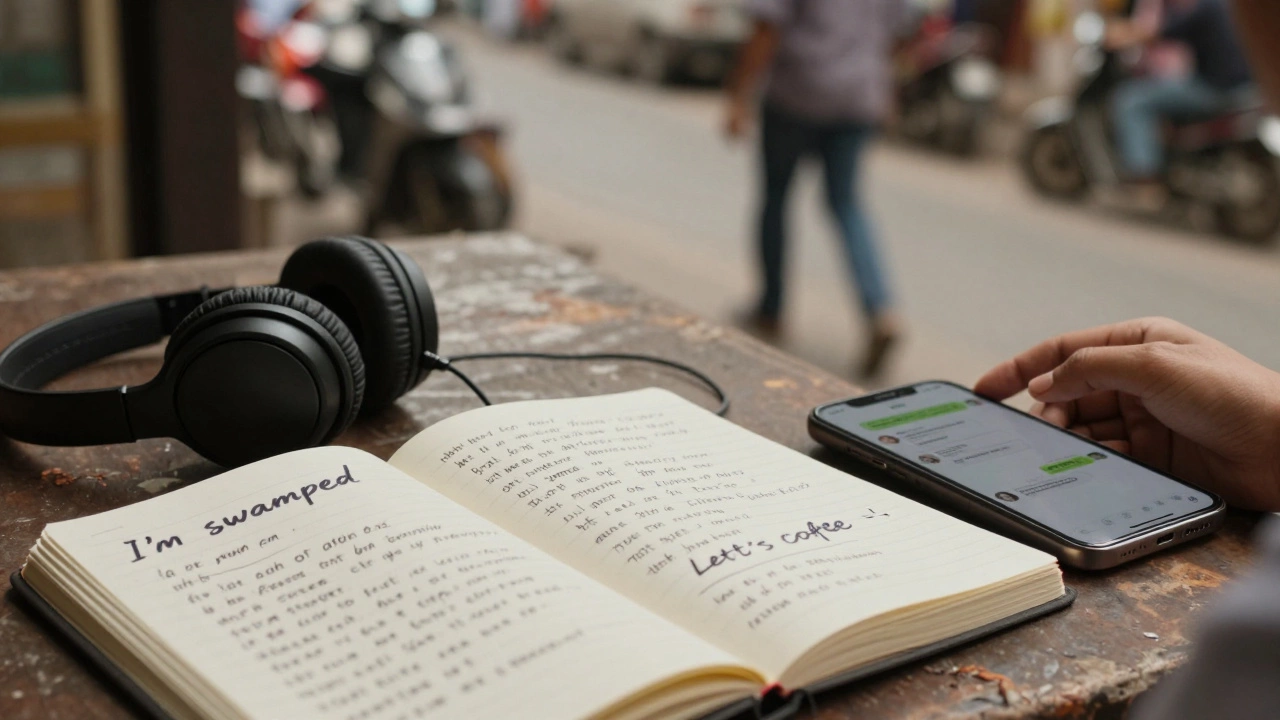
Instead of memorizing definitions, collect phrases. When you hear someone say, "I’m swamped this week," write it down. When you hear, "Let’s grab a coffee," save it. These are the building blocks of real English. Keep a notebook - digital or paper - where you store 3-5 new phrases every day. Review them every morning. Try using one in a text or voice message. Soon, they’ll come out naturally.
Record yourself - and listen without judgment
Most people hate the sound of their own voice. But if you want to improve, you have to hear yourself like a native speaker would. Record yourself speaking for 1 minute. Talk about your day, your weekend, or your favorite food. Then listen back. Don’t focus on mistakes. Focus on patterns: Do you pause too much? Do you rush? Do you repeat words? Do you use the same sentence starters every time?
Do this once a week. After a month, you’ll hear progress. You’ll notice your pauses getting shorter, your sentences flowing better. You’ll start catching your own errors before you even say them.
Think in English - even when you’re not speaking
When you think in your native language and then translate to English, you slow yourself down. You get stuck. You overthink. To speak fluently, you need to think directly in English.
Start small. When you’re walking, describe what you see: "That man is carrying a bag," "The sky is gray," "I’m hungry." When you’re waiting in line, think about what you’d say if you had to ask a question: "How long is this line?" "Do you have this in blue?" You don’t need to speak out loud. Just think it. Your brain will start forming thoughts in English instead of translating them.
Embrace mistakes - they’re your best teacher
Every native speaker made mistakes when they were learning. They said "I goed" instead of "I went." They mixed up "there," "their," and "they’re." They used the wrong tense. And guess what? People still understood them.
Don’t let fear of mistakes hold you back. If you say "I have 20 year," and someone corrects you, thank them. Then say it again correctly: "I’m 20 years old." That’s how you learn. Mistakes aren’t failures - they’re data points. They tell you exactly where to focus next.
Make English part of your routine - not a chore
You don’t need to spend hours a day. You need consistency. Try this daily routine:
- 5 minutes: Shadow a short audio clip
- 10 minutes: Listen to a podcast while doing dishes or walking
- 5 minutes: Say 3 new phrases out loud
- 10 minutes: Text or call a language partner
That’s 30 minutes total. Do it every day. No exceptions. In 30 days, you’ll notice a shift. In 90 days, people will start asking, "When did you start speaking English so well?"
What to avoid
- Waiting for "perfect" time to speak
- Only practicing with other non-native speakers (unless they’re advanced)
- Using translation apps mid-conversation
- Trying to sound "smart" instead of being clear
- Comparing yourself to native speakers
Fluency isn’t about perfection. It’s about connection. If someone understands you, you’ve succeeded.
How long does it take to speak English fluently?
There’s no fixed timeline, but most people who practice daily see major improvement in 3 to 6 months. Fluency doesn’t mean sounding like a native speaker - it means you can handle everyday conversations without stress. If you’re speaking for at least 20 minutes a day, you’ll notice progress within weeks. The key isn’t time - it’s consistency.
Do I need to take a course to improve my speaking?
Courses can help, especially if they focus on conversation, but they’re not required. Many people improve faster with free resources - podcasts, language exchange apps, YouTube channels - because they’re more real and flexible. A course is useful if you need structure or feedback. But if you’re willing to practice daily on your own, you don’t need to pay for one.
I’m shy. How do I start speaking with strangers?
Start with low-pressure situations. Text a language partner first. Join online groups where people are also learning. Try speaking to cashiers or baristas - even just saying "Thank you" or "How’s your day?" Most people are happy to help. You’re not performing. You’re practicing. Every small interaction builds confidence.
What if I don’t understand native speakers?
It’s normal. Native speakers talk fast, use slang, and sometimes mumble. Start with slower content - like BBC Learning English or TED Talks with subtitles. Then gradually move to real-life videos. Don’t panic if you miss a word. Focus on the context. If you don’t understand, say: "Can you repeat that?" or "Do you mean ___?" Most people will slow down and help. Understanding improves with exposure - not memorization.
Should I focus on accent or clarity?
Focus on clarity. A clear voice with correct word order and stress is more important than a perfect accent. People understand you better if you speak slowly and emphasize key words. A strong accent doesn’t matter if your message gets through. Many successful English speakers have accents. What matters is that you’re understood - not that you sound like someone from London or New York.