The Most Feared Subject in Competitive Exams: Why Math and Logic Scare Students

Math Anxiety & Fear Level Calculator
Answer these questions honestly to determine your current anxiety level regarding Mathematics and Logical Reasoning sections in competitive exams.
Subject Fear Comparison
Analysis
Recommended Strategies:
You sit down to open your textbook. Your heart starts racing before you even read the first question. You look at the page, and suddenly, numbers blur together, or a complex diagram looks like a puzzle with no solution. If this sounds familiar, you are not alone. Across the globe, millions of students preparing for competitive exams share a common secret: there is one subject that consistently ranks as the most feared.
Whether you are aiming for government jobs, engineering seats, or medical colleges, the data points to a clear winner. Mathematics-or more broadly, Quantitative Aptitude and Logical Reasoning-is the subject that causes the most stress, avoidance, and fear among test-takers. But why does this specific subject trigger such a strong emotional response? And more importantly, how can you stop fearing it?
The Psychology Behind the Fear
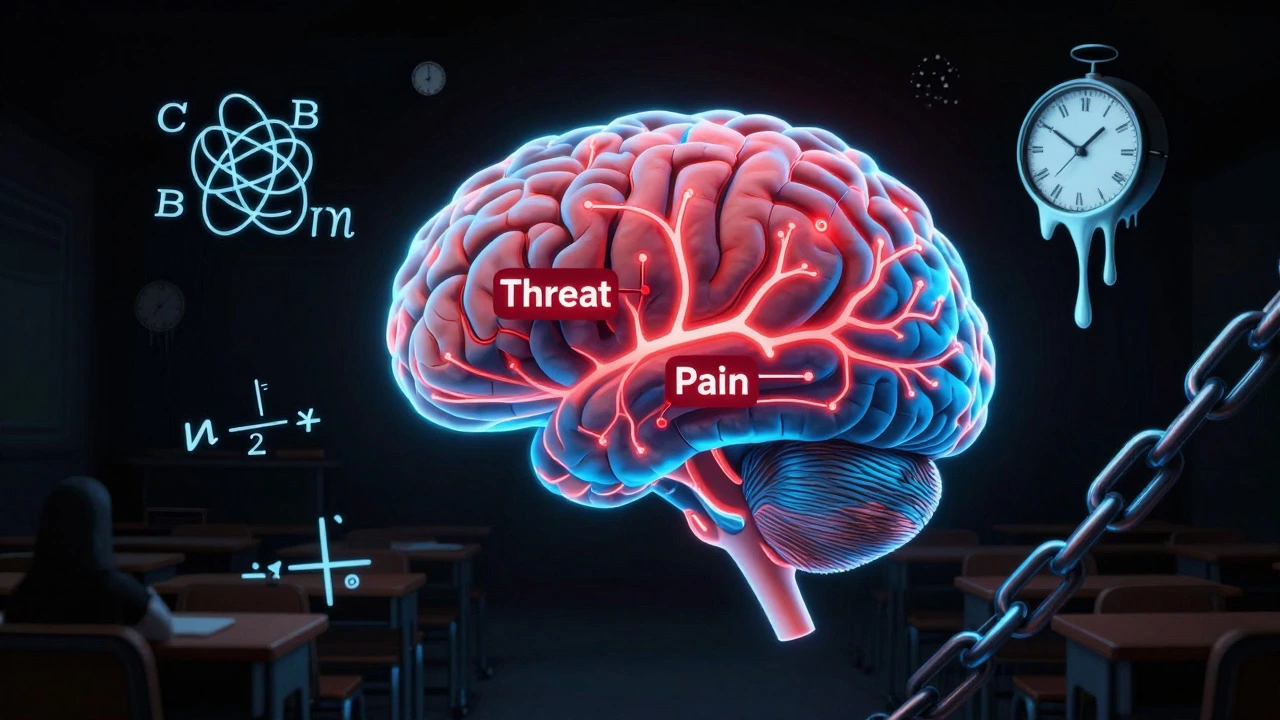
Fear of mathematics is not just about being "bad at numbers." It is a deep-seated psychological phenomenon known as math anxiety. Research suggests that when people face difficult math problems, their brains activate the same regions associated with physical pain and threat detection. This isn't a metaphor; it is a biological reaction.
In the context of competitive exams, this anxiety is amplified by high stakes. These exams often determine career trajectories, social status, and financial stability. When you combine the pressure of a single-chance exam with a subject that feels abstract and unforgiving, the result is panic. Many students report feeling a sense of shame if they cannot solve a problem quickly, leading to a cycle of avoidance. The more they avoid it, the worse they get, and the greater the fear becomes.
This fear is particularly pronounced in timed environments. Unlike literature or history, where you might have time to think through an argument, math questions often require quick recall and execution. A small error in calculation can invalidate an entire answer. This lack of margin for error creates a perfectionist trap that paralyzes many candidates.
Why Math Tops the List of Feared Subjects
While opinions vary slightly depending on the specific exam, Mathematics (or its equivalents like Data Interpretation and Analytical Ability) consistently emerges as the top contender for the "most feared" title. Here is why it holds this unfortunate reputation:
- Abstract Nature: Concepts like calculus, algebra, or probability do not always have immediate real-world analogs for beginners. They feel disconnected from daily life, making them harder to grasp intuitively.
- Cumulative Difficulty: Math builds on itself. If you miss a concept in Chapter 3, Chapter 4 becomes impossible. In competitive exams, syllabi are vast, meaning gaps in foundational knowledge create massive roadblocks later on.
- Speed Pressure: Competitive exams are marathons run at sprint speeds. Solving complex equations under strict time limits requires a level of fluency that takes years to develop. For those who rely on rote memorization rather than conceptual understanding, speed is a nightmare.
- Binariness of Answers: In essay-based subjects, you can argue a point and still earn partial credit. In math, the answer is either right or wrong. There is no middle ground, which increases the perceived risk of attempting a question.
| Subject Area | Primary Source of Anxiety | Average Student Rating (1-10) |
|---|---|---|
| Mathematics/Quant | Calculation errors, time pressure, abstract concepts | 9.2 |
| Logical Reasoning | Complex patterns, trick questions | 8.5 |
| General Science | Vast syllabus, memory load | 7.0 |
| Verbal Ability | Vocabulary size, grammar rules | 6.5 |
| Current Affairs | Constant updates, volume of news | 6.0 |
Note that while General Knowledge and Current Affairs are stressful due to the sheer volume of information, they rarely induce the same visceral panic as Math. You can guess a fact; you cannot guess a mathematical proof.
The Role of Teaching Methods
A significant portion of this fear stems from how these subjects are taught in school systems worldwide. Traditional education often emphasizes rote memorization of formulas over conceptual understanding. Students are told to "learn this formula" without understanding why it works. When faced with a novel problem in a competitive exam that doesn't match the textbook example exactly, they freeze.
Furthermore, early negative experiences play a huge role. If a student was publicly criticized for getting a math problem wrong in fifth grade, that trauma lingers into adulthood. Teachers who prioritize speed over understanding inadvertently train students to associate math with failure and embarrassment. This educational legacy is something every serious exam aspirant must actively work to overcome.
Strategies to Overcome the Fear
Knowing that Math is the most feared subject is only half the battle. The other half is changing your relationship with it. Here are practical, proven strategies to reduce anxiety and improve performance:
- Start with the Basics: Don't jump into advanced problems if your foundation is shaky. Spend a week reviewing arithmetic, basic algebra, and geometry principles. Confidence grows when you understand the "why" behind the "how."
- Practice Under Timed Conditions: Anxiety thrives in uncertainty. By regularly practicing with a timer, you desensitize yourself to the pressure. Start with generous time limits and gradually reduce them as your speed improves.
- Focus on Accuracy First: In many competitive exams, negative marking penalizes wrong answers. Train yourself to pick questions you are sure of. Leaving a question blank is often better than guessing wildly. This strategic approach reduces the fear of losing marks.
- Use Visualization: Try to visualize problems rather than just calculating them. Drawing diagrams for word problems or geometric shapes can make abstract concepts concrete and easier to manage.
- Reframe Failure: View mistakes as data points, not personal failures. Every wrong answer tells you exactly what you need to study next. Keep an error log to track recurring mistakes.
Is It Always Math?
While Math is the global leader in fear-inducing subjects, context matters. For students preparing for language-heavy exams like law entrance tests or journalism competitions, Verbal Ability and Reading Comprehension might be the biggest hurdles. Similarly, for creative fields, portfolio assessments can be more daunting than written tests.
However, in the realm of standardized competitive exams-such as civil services, engineering entrances, and banking tests-the quantitative section remains the great equalizer and the greatest source of dread. Its objective nature makes it impossible to bluff your way through, forcing candidates to confront their weaknesses head-on.

The Impact on Exam Strategy
Understanding that Math is the most feared subject allows you to craft a smarter exam strategy. Since many competitors will skip or rush through math questions due to anxiety, mastering this section gives you a disproportionate advantage. While others are panicking over a percentage calculation, you can be calmly solving it and moving on.
This is the paradox of competitive exams: the thing everyone fears is often the easiest place to gain an edge. By confronting your fear directly, you turn a weakness into your strongest weapon. The goal is not to become a mathematician overnight, but to reach a level of comfort where the subject no longer controls your emotions.
Building Long-Term Resilience
Overcoming the fear of the most dreaded subject is a marathon, not a sprint. It requires consistent effort, patience, and self-compassion. Celebrate small victories. Did you solve a problem today that seemed impossible last week? That is progress. Did you complete a mock test without freezing up? That is growth.
Remember that thousands of successful professionals once sat where you are now, staring at a math problem with trembling hands. They didn't succeed because they were naturally gifted; they succeeded because they refused to let fear dictate their potential. You can do the same.
Why do students fear mathematics in competitive exams?
Students fear mathematics due to a combination of factors including abstract concepts, cumulative difficulty, high-stakes pressure, and the binary nature of right/wrong answers. Early negative educational experiences and poor teaching methods that emphasize rote learning also contribute significantly to this anxiety.
Is Mathematics really the most feared subject across all types of exams?
For most standardized competitive exams like engineering, banking, and civil services, yes, Mathematics (or Quantitative Aptitude) is the most feared. However, for language-focused or creative exams, subjects like Verbal Ability or Portfolio Assessments may rank higher in terms of student anxiety.
How can I overcome math anxiety during exam preparation?
You can overcome math anxiety by strengthening your foundational concepts, practicing under timed conditions to build stamina, focusing on accuracy over speed initially, and reframing mistakes as learning opportunities. Consistent practice and visualization techniques also help reduce fear.
Does skipping math questions hurt my score in competitive exams?
It depends on the exam's marking scheme. In exams with negative marking, skipping uncertain questions is often a smart strategy to preserve scores. However, since many students skip math due to fear, mastering it can give you a significant competitive advantage if you can maintain accuracy.
What role do teachers play in creating fear of certain subjects?
Teachers can inadvertently create fear by emphasizing rote memorization over conceptual understanding, prioritizing speed over comprehension, or using public criticism for mistakes. Positive reinforcement and encouraging curiosity can help mitigate this fear.