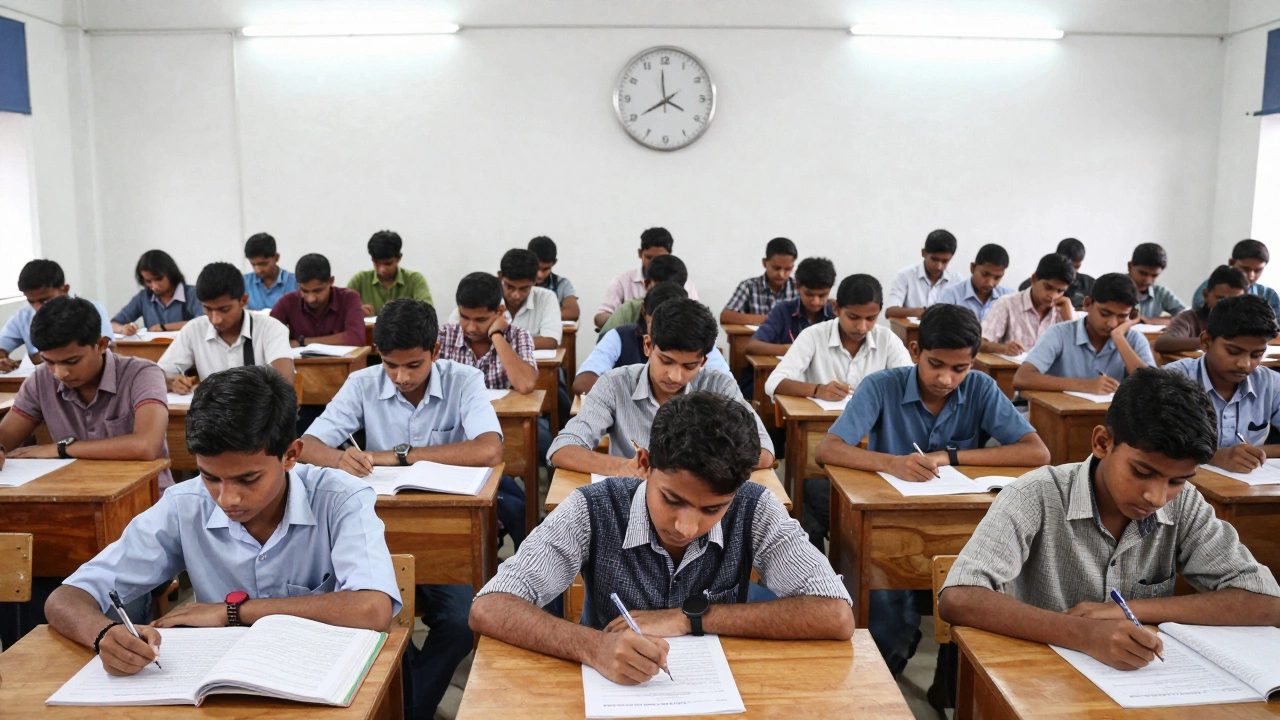
What Makes a Person Extremely Competitive? Psychology of Exam Success

Competitive Mindset & Burnout Calculator
Are you driven by healthy ambition or toxic anxiety? Use this calculator to evaluate your current psychological state regarding competitive exams. Answer honestly for accurate insights.
Assessment Questions
Fill out the assessment to see your personalized psychological profile and strategy tips.
You’ve seen them. The student who seems to have an endless reservoir of energy, the one who treats every mock test like a life-or-death battle, and the candidate who studies until their eyes burn because stopping feels like failure. We often label these people as "naturally competitive." But is competitiveness just a personality trait you’re born with, or is it something you can build? If you are preparing for competitive exams, understanding the mechanics behind extreme competitiveness isn't just interesting psychology-it's a strategic advantage.
It’s easy to assume that highly competitive people are simply smarter or work harder. That’s only half the story. True competitiveness in high-stakes environments, like the UPSC, JEE, or NEET, stems from a specific mix of psychological drivers, environmental triggers, and cognitive habits. It’s not about being aggressive; it’s about having a relentless focus on improvement. Let’s break down what actually drives this behavior and how you can harness it without burning out.
The Psychology Behind the Drive
At its core, extreme competitiveness is fueled by Achievement Motivation. This is a psychological concept defined as the desire to excel, especially in competition with others. Unlike simple ambition, which might be vague ("I want a good job"), achievement motivation is specific and measurable ("I need to score in the top 0.1%").
People with high achievement motivation don’t just want to pass; they want to dominate. They derive self-worth from performance metrics. In the context of competitive exams, this manifests as a refusal to accept "good enough." A student scoring 95% might feel disappointed if the previous year’s cutoff was 96%. This isn't perfectionism for the sake of aesthetics; it’s a survival mechanism in a zero-sum game where ranks matter more than raw scores.
Another key driver is Loss Aversion. Behavioral economics tells us that humans feel the pain of losing twice as strongly as the pleasure of gaining. For extremely competitive candidates, the fear of missing a rank by one mark outweighs the joy of getting it right. This anxiety, when channeled correctly, becomes hyper-vigilance. They double-check answers. They memorize edge cases. They study the syllabus changes before anyone else does.
Nature vs. Nurture: Are You Born This Way?
Is competitiveness genetic? Partly. Studies suggest that traits like conscientiousness and neuroticism have heritable components. Conscientious individuals are organized and disciplined-essential for long-term exam prep. Neurotic individuals are sensitive to stress and negative feedback, which can drive them to avoid failure at all costs.
However, environment plays a massive role. Consider the culture in many Asian and Australian households where academic success is tied to family honor or social status. When parents praise results rather than effort, children learn to compete for validation. This external pressure internalizes over time. What starts as studying to please mom and dad becomes studying to prove a point to oneself.
In Australia, while the culture is generally laid-back, the competitive nature of university admissions (like ATAR scores) creates pockets of intense rivalry. Students in selective schools often report feeling pressured to outperform peers not just for grades, but for future career prospects. This environmental conditioning shapes the brain to view peers not as collaborators, but as benchmarks.
The Role of Feedback Loops
Highly competitive people thrive on immediate feedback. In a classroom, you wait weeks for a grade. In competitive exam preparation, successful students create their own feedback loops. They take daily quizzes. They track accuracy rates. They analyze error logs.
This constant data collection allows them to adjust strategies rapidly. If a student realizes they are consistently losing marks in Organic Chemistry mechanisms, they pivot their study plan immediately. Non-competitive students might ignore these signals until the final exam. The competitive mind treats every mistake as a data point to be fixed, not a judgment on their intelligence.
| Feature | Average Student | Extremely Competitive Student |
|---|---|---|
| Goal Setting | Pass the exam | Secure a specific rank percentile |
| Error Handling | Moves on quickly | Analyzes root cause deeply |
| Study Schedule | Flexible, reactive | Rigid, proactive, optimized |
| Peer Interaction | Social support | Benchmarking and comparison |
| Resource Use | Standard textbooks | Multiple sources, past papers, expert tips |

Environmental Triggers and Social Comparison
We live in an age of constant comparison. Social media amplifies this. Seeing friends post about their internships or top scores triggers a response in the brain’s reward system. For competitive individuals, this isn’t just envy; it’s a call to action.
Research in social psychology highlights the "Relative Deprivation Theory." People evaluate their success based on comparisons with similar others. If you are surrounded by high achievers, your baseline for success shifts upward. This is why joining a coaching institute or a serious study group can boost competitiveness. The ambient pressure raises the bar. Suddenly, studying six hours a day feels inadequate because everyone around you is doing eight.
But there’s a trap here. Unchecked social comparison leads to anxiety. The healthiest form of competitiveness uses peers as mirrors, not judges. Instead of thinking, "They are better than me," the competitive mindset shifts to, "If they can do it, so can I. What are they doing differently?"
Cognitive Habits of Top Performers
Extreme competitiveness translates into specific cognitive habits. These aren’t mystical talents; they are trainable skills.
- Active Recall: Instead of re-reading notes, competitive students force themselves to retrieve information from memory. This strengthens neural pathways.
- Spaced Repetition: They use algorithms (like Anki) to review material just before forgetting it. This maximizes retention efficiency.
- Interleaving: They mix different topics during study sessions. Solving algebra problems after geometry problems forces the brain to distinguish between concepts, improving problem-solving flexibility.
- Stress Inoculation: They simulate exam conditions frequently. By practicing under pressure, they reduce the shock of the actual test day.
These habits require discipline, which is the engine of competitiveness. Without discipline, competitiveness is just anxiety. With discipline, it becomes power.

The Dark Side: Burnout and Identity Crisis
Being extremely competitive has costs. The most common is burnout. When your self-worth is tied entirely to outcomes, a bad score feels like a personal failure. This emotional volatility can lead to paralysis. Some students stop studying because they are afraid of confirming their fears of inadequacy.
Another risk is the "hedonic treadmill." Once you achieve a goal, the satisfaction fades quickly, and you immediately look for the next challenge. This prevents you from enjoying the present moment. In the context of education, this means missing out on the joy of learning. You become a test-taking machine rather than a curious scholar.
To mitigate this, competitive individuals need to separate their identity from their achievements. You are not your rank. You are a person who works hard. This distinction provides resilience. If you fail, you haven’t lost your worth; you’ve just identified a gap in your strategy.
How to Cultivate Healthy Competitiveness
If you don’t feel naturally competitive, don’t worry. You can develop it. Here is a practical approach:
- Set Micro-Goals: Break your syllabus into small, manageable chunks. Celebrate completing each chunk. This builds momentum.
- Find Your Rivals: Identify one or two peers who are slightly ahead of you. Use them as pace-setters. Don’t try to beat everyone; just beat yesterday’s version of yourself.
- Track Progress Visually: Use charts to show your improvement over time. Seeing a line graph go up releases dopamine, reinforcing the habit.
- Limit Negative Comparisons: Curate your social media feed. Follow accounts that share study tips, not just highlight reels of success.
- Prioritize Recovery: Treat sleep and exercise as part of your study schedule. A rested brain competes better than an exhausted one.
Remember, the goal isn’t to crush your opponents. It’s to maximize your potential. In competitive exams, the real enemy isn’t the person sitting next to you; it’s the version of you that gives up too easily.
Is competitiveness good for mental health?
It depends on how it’s managed. Healthy competitiveness drives motivation and achievement. However, toxic competitiveness, where self-worth is solely dependent on winning, can lead to anxiety, depression, and burnout. Balancing drive with self-compassion is key.
Can introverts be extremely competitive?
Absolutely. Introverts often channel competitiveness internally through deep focus and meticulous preparation. They may not engage in overt rivalry, but their drive to master the material and achieve top results can be incredibly intense.
Does competition help or hurt learning?
Moderate competition enhances performance by increasing alertness and effort. However, excessive competition can hinder deep learning by encouraging rote memorization over conceptual understanding. Collaborative learning often complements competitive drive by filling knowledge gaps.
How do I stop comparing myself to others?
Shift your focus from outcome-based comparisons to process-based improvements. Instead of asking "Did I score higher than X?", ask "Did I understand this concept better than last week?" Tracking personal progress reduces the noise of external comparisons.
Is natural talent more important than competitiveness?
In competitive exams, consistency usually beats raw talent. Natural ability provides a head start, but sustained competitiveness ensures the endurance needed to cover vast syllabi and handle high-pressure situations. Most top performers rely on disciplined habits rather than innate genius.