What is the Easiest School to Get an MBA? Admission Realities for 2026
MBA Admission Difficulty Estimator
Adjust the sliders below to match your profile. This tool estimates which "accessible" schools mentioned in the article might be a good fit for you.
Your Best Fits
There is no such thing as a truly "easy" Master of Business Administration degree if you want it to hold weight in the job market. However, there are definitely MBA programs with lower barriers to entry. When people ask this question, they usually mean one of two things: they want a school that doesn’t require a high GMAT score, or they want a program that allows them to study while working full-time without demanding their entire life.
The reality of the 2026 landscape is that accessibility has increased dramatically due to the rise of hybrid and online formats. Schools like Indiana University Kelley and University of Illinois Gies have built reputations for being highly accessible while still maintaining accreditation from the AACSB. This means you can get a respectable credential without needing a perfect undergraduate GPA or a seven-figure salary to pay tuition upfront.
Defining "Easy" in MBA Admissions
To find the right fit, you first need to define what "easy" means for your specific situation. Most applicants fall into three categories based on their constraints.
1. The Test-Averse Applicant You might be great at leading teams but terrible at standardized tests. For you, "easy" means finding schools with generous GMAT waivers. Many top-tier public universities now waive the test requirement if you have significant work experience or a strong undergraduate GPA in a quantitative field.
2. The Time-Poor Professional If you are working 50 hours a week, a traditional two-year residential MBA is not just hard; it’s impossible. In this case, "easy" refers to flexibility. Online MBAs from schools like Southern New Hampshire University (SNHU) or University of Phoenix are designed for speed and convenience. They accept a wide range of transfer credits and offer asynchronous classes.
3. The Budget-Conscious Student Tuition can be a barrier. An "easy" financial path often involves looking at state-funded universities that offer in-state rates even for online students, or programs with transparent, fixed pricing models rather than variable costs.
Top Contenders for Accessible MBAs in 2026
If we look at acceptance rates, average GMAT scores, and flexibility, several institutions stand out as having the lowest friction for entry. These are not "diploma mills." They are legitimate, accredited institutions that prioritize volume and accessibility over exclusivity.
| School | Avg. GMAT (if required) | Key Feature | Accreditation |
|---|---|---|---|
| Indiana University Kelley | ~580 | Strong GMAT waiver policy | AACSB |
| University of Illinois Gies | ~570 | Holistic review process | AACSB |
| SNHU | Not Required | No entrance exam needed | AACSB |
| Arizona State University | ~590 | High acceptance rate | AACSB |
| Purdue Global | Not Required | Fast-track options | AACSB |
Southern New Hampshire University is perhaps the most famous example of low-barrier entry. They do not require the GMAT or GRE for most applicants. Their admissions team looks primarily at your professional experience and academic history. If you have a bachelor’s degree with a decent GPA, you are likely in. The trade-off is that the brand name does not carry the same weight as Harvard or Wharton, but for mid-level management roles, it is often sufficient.
Purdue Global operates similarly. It is a for-profit institution focused on serving non-traditional students. They offer accelerated terms, meaning you can potentially finish the degree faster than traditional peers. This is ideal if your goal is simply to check the "MBA" box on your resume quickly.
The Role of Accreditation: Why It Matters More Than Rankings
When chasing the "easiest" path, the biggest risk is ending up with a degree that employers ignore. This is where AACSB International comes into play. The Association to Advance Collegiate Schools of Business accredits only about 5-7% of business schools worldwide.
If a school claims to be easy to get into but lacks AACSB accreditation, proceed with extreme caution. Employers use accreditation as a filter. A degree from an unaccredited institution might save you time and money upfront, but it could cost you opportunities later. Always verify the accreditation status on the official AACSB website before applying.
For example, many international online universities offer cheap, fast MBAs. While these might be legal, they rarely have regional or national accreditation recognized in the US or major global markets. Stick to schools that are regionally accredited in the US or have equivalent recognition in your home country.
Navigating the Application Process for High-Acceptance Schools
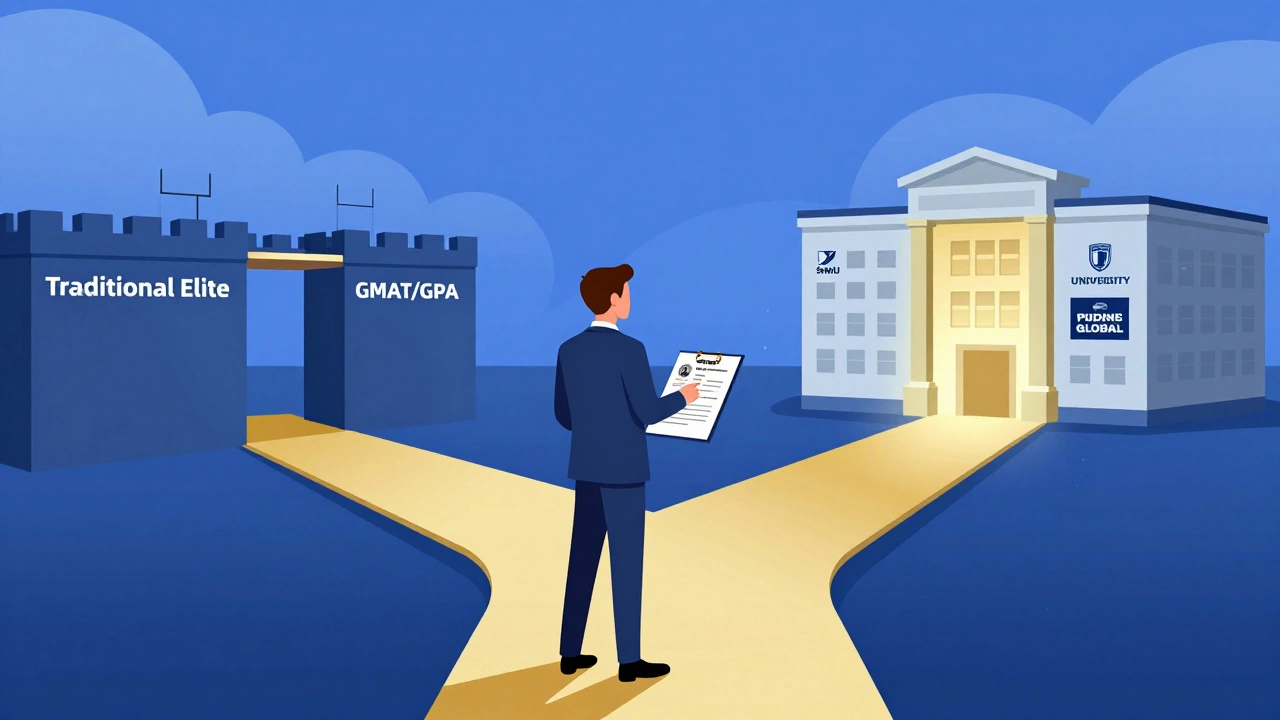
Even if a school has a high acceptance rate, you cannot just submit an empty folder. To ensure smooth admission, follow these steps:
- Gather Professional Evidence: Since the GMAT is often waived, your resume becomes the primary metric. Highlight leadership roles, revenue growth, or team management. Quantify your achievements.
- Write a Clear Essay: High-accessibility schools receive thousands of applications. Your essay should clearly state why you want the MBA and how you plan to use it. Avoid generic fluff. Be specific about your career goals.
- Secure Strong Recommendations: Choose recommenders who know your work ethic well. A letter from a direct supervisor carries more weight than one from a professor you took a class with five years ago.
- Check Transfer Credits: If you have taken graduate-level business courses previously, ask if they can be transferred. This can reduce the number of classes you need to take, making the program financially and temporally "easier" to complete.
Online vs. On-Campus: The Flexibility Factor
In 2026, the distinction between online and on-campus MBAs has blurred significantly. Top schools like University of North Carolina Kenan-Flagler offer fully online degrees that are identical to their campus versions. However, for those seeking the easiest entry, dedicated online platforms often have more streamlined admissions processes.
On-campus programs often require interviews, which add a layer of subjectivity and stress. Online programs frequently replace interviews with video essays or written responses, which are less intimidating and easier to prepare for. If social anxiety or scheduling conflicts are part of your definition of "hard," the online route is objectively easier.

Common Pitfalls to Avoid
Chasing ease can lead to costly mistakes. Here are three traps to watch out for:
- The "Diploma Mill" Trap: Avoid schools that promise a degree in six months with no coursework. These are almost always scams or unaccredited entities. Legitimate education requires effort.
- Igoring Career Services: An easy-to-get-into school is useless if it doesn't help you land a job. Check if the school offers career coaching, alumni networks, and recruitment events. SNHU and Purdue Global invest heavily in these areas.
- Underestimating the Workload: Just because admission is easy doesn't mean graduation is. Online MBAs still require rigorous case studies, group projects, and exams. Drop-out rates in online programs can be higher than on-campus ones because students underestimate the time commitment.
Is an "Easy" MBA Worth It?
The value of an MBA depends entirely on your current career stage. If you are early in your career and looking to pivot industries, a highly selective MBA from a prestigious school might be necessary to break through HR filters. However, if you are already established in a role and need the credential for a promotion, a salary bump, or to qualify for executive training, an accessible MBA from a reputable, accredited school is a smart, efficient choice.
Employers care less about how hard it was to get into the school and more about what you did with the degree. If you combine an accessible MBA with practical application of skills-such as leading a new project or improving operational efficiency-you demonstrate value regardless of the school's selectivity.
Which MBA programs do not require the GMAT?
Many accredited programs offer GMAT waivers, including Southern New Hampshire University (SNHU), Purdue Global, Indiana University Kelley, and University of Illinois Gies. Some may require a minimum undergraduate GPA or a certain amount of work experience instead.
Is an online MBA respected by employers?
Yes, provided the program is accredited by a recognized body like AACSB. In 2026, most employers view online and on-campus degrees from the same institution as equivalent. The key is the reputation of the university, not the delivery method.
What is the cheapest way to get an MBA?
Public universities often offer the best value, especially if you qualify for in-state tuition rates even for online programs. Schools like Arizona State University and University of Illinois offer competitive pricing compared to private institutions. Employer sponsorship is another way to reduce personal cost.
Can I get an MBA with a low GPA?
Yes. Many holistic-review schools consider professional experience, letters of recommendation, and personal statements alongside GPA. If your undergraduate GPA is below 3.0, you can compensate by showing recent graduate coursework or significant career progression.
How long does it take to complete an online MBA?
Most standard online MBA programs take 2 to 3 years to complete while working full-time. Accelerated programs offered by schools like Purdue Global or SNHU can be finished in as little as 12 to 18 months if you take a heavier course load each term.