Which Are the 3 Toughest Exams in India?

Every year, millions of students in India sit for exams that can change their lives. But only a few are truly brutal - not just because of the syllabus, but because of the stakes, the competition, and the sheer pressure. If you’re asking which are the three toughest exams in India, the answer isn’t about how hard the questions are. It’s about how many people are fighting for a tiny slice of the pie.
IIT JEE: The Engineering Gauntlet
More than 1.5 million students take the Joint Entrance Examination (JEE) Main every year. Only about 250,000 qualify for JEE Advanced. Of those, roughly 10,000 get into one of the 23 IITs. That’s a selection rate of less than 0.7%. The exam doesn’t just test knowledge - it tests endurance. You need to master physics, chemistry, and math at a level most college freshmen never reach. The questions are designed to separate the top 0.1%.
There’s no room for guesswork. A single misread question or calculation error can drop you hundreds of ranks. Students often start preparing in class 8 or 9. Coaching centers in Kota churn out thousands of aspirants, many working 14-hour days for years. The pressure doesn’t just come from the exam. It comes from family expectations, social status, and the belief that if you don’t get into an IIT, your future is over.
NEET: The Medical Minefield
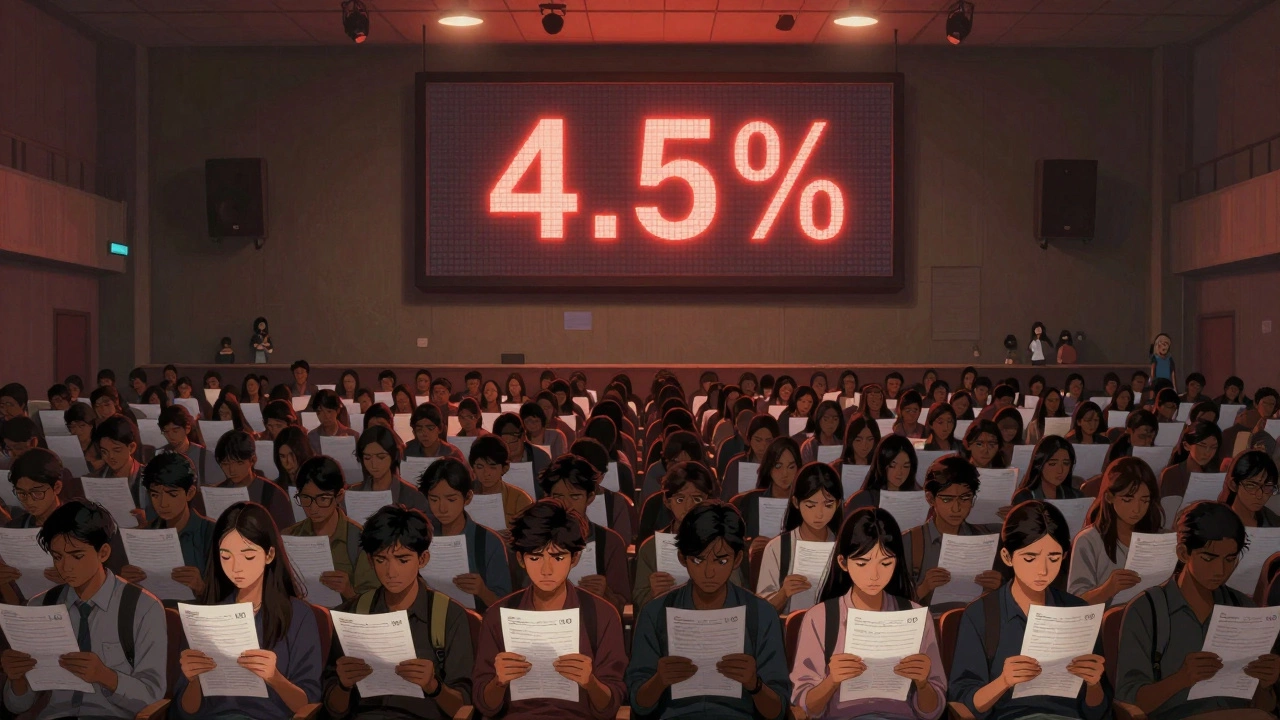
If IIT JEE is about logic and speed, NEET (National Eligibility cum Entrance Test) is about volume and precision. Over 2.3 million students appear for NEET each year. Only about 100,000 seats are available across all medical colleges - including government, private, and deemed universities. That’s a selection rate of less than 5%. And unlike JEE, where you can try again next year with minimal penalty, NEET has a hard cutoff: you can only attempt it three times after turning 17.
The syllabus covers biology, chemistry, and physics - but biology alone has over 1,500 pages of detailed content. You need to memorize every organ, every enzyme, every plant species, every genetic disorder. One wrong answer in the 200-question paper can cost you a seat. The exam is held in 13 languages, and even then, translation errors have led to protests. Many students spend years studying from NCERT textbooks, revising the same chapters dozens of times. The competition isn’t just among peers - it’s against the system. Reserved category cutoffs change every year. A student scoring 650 might not get a seat in Delhi, while someone with 580 gets one in a remote state.
UPSC CSE: The Ultimate Test of Mastery
UPSC Civil Services Examination is not just an exam. It’s a multi-year ordeal. Over 1.1 million applicants apply each year. Around 10,000 clear the preliminary exam. Only 1,800 make it to the final merit list. And only about 700 get IAS, IPS, or IFS - the most coveted posts. The exam spans three stages: Prelims, Mains, and Interview. The Mains alone has nine papers, including two language papers and seven descriptive essays on topics ranging from Indian heritage to global geopolitics.
You don’t just need to know facts. You need to analyze them. You need to write 15,000 words across eight days - with clarity, structure, and originality. The interview panel doesn’t test memory. They test character. They ask about your views on caste discrimination, climate policy, or digital privacy. One candidate was asked, “How would you handle a village where 80% of the women are illiterate?” Another was asked to explain quantum entanglement in simple terms.
Success here doesn’t come from coaching alone. It comes from reading 50+ books, writing daily answer practice, following current affairs like a journalist, and maintaining mental stamina for over a year. The average candidate takes 2-3 attempts before clearing it. Many quit after failing the Mains - not because they didn’t know the subject, but because they couldn’t write under pressure.
Why These Three Stand Out
These exams aren’t tough just because they’re hard. They’re tough because they’re gatekeepers to careers that define social mobility in India. An IIT graduate earns 3-5x the average starting salary. A doctor from a government college gets job security and respect. An IAS officer controls budgets, policies, and lives.
Compare them to other competitive exams - like SSC CGL or RBI Grade B. Those are hard, yes. But they don’t have the same scale of competition or the same long-term consequences. UPSC, NEET, and JEE aren’t just tests. They’re life-altering filters.
What Makes Them Different From Other Exams
Other exams test what you’ve learned. These three test what you’ve sacrificed.
They demand:
- Time: 2-4 years of focused preparation, often at the cost of childhood, social life, and mental health.
- Consistency: No breaks. No vacations. No holidays. Daily revision, mock tests, and feedback loops.
- Resilience: You will fail. You will doubt yourself. You will feel broken. Only those who get up again make it.
- Strategy: Memorization won’t save you. You need to understand patterns, anticipate trends, and adapt.
There’s no shortcut. No magic trick. No app that can replace 1,000 hours of practice.
What Happens After You Clear Them?
Clearing one of these exams doesn’t mean the pressure ends. IITians face placement pressure. Doctors face 36-hour shifts. IAS officers face political interference and public scrutiny. But the difference is this: once you clear it, you’re no longer fighting for survival. You’re fighting to make a difference.
That’s why millions still try. Not because it’s easy. But because it’s worth it.

Is There a Fourth Tough Exam?
Some argue for the GATE exam, which opens doors to PSUs and M.Tech programs. Others point to the CFA Level 1 for finance aspirants. But none match the scale. GATE has about 800,000 applicants - still half of UPSC’s numbers. CFA is expensive and niche. These three - JEE, NEET, UPSC - are the only ones that affect the lives of millions, regardless of region, language, or income.
| Exam | Annual Applicants | Selection Rate | Key Subjects | Duration of Preparation | Attempts Allowed |
|---|---|---|---|---|---|
| IIT JEE | 1.5 million+ | 0.7% | Physics, Chemistry, Mathematics | 2-4 years | 3 (for JEE Advanced) |
| NEET | 2.3 million+ | 4.5% | Biology, Chemistry, Physics | 2-5 years | 3 (after age 17) |
| UPSC CSE | 1.1 million+ | 0.06% | General Studies, Optional Subject, Essay | 1-3 years | 6 (until age 32) |
Frequently Asked Questions
Is NEET tougher than IIT JEE?
It depends on what you mean by “tough.” JEE tests problem-solving under time pressure with complex math and physics. NEET tests memory and accuracy across a massive biology syllabus. JEE has a lower selection rate, so statistically, it’s harder to crack. But NEET feels harder because one mistake can cost you a seat, and the competition is even bigger. Both are brutal in their own way.
Can you crack UPSC without coaching?
Yes. Around 30-40% of UPSC toppers are self-prepared. Coaching helps with structure, answer writing, and current affairs tracking - but it doesn’t replace personal effort. Many successful candidates rely on NCERT books, online lectures, and free study materials. What matters is consistency, feedback, and discipline - not the name of the coaching center.
Why do so many students fail these exams?
Most fail because they prepare for the wrong reasons. They follow trends, not passion. They memorize without understanding. They skip answer writing practice. They don’t analyze past papers. And they burn out. The exams don’t test intelligence - they test persistence. The ones who fail aren’t less smart. They’re just less consistent.
Are these exams fair to students from rural areas?
The system has flaws. Rural students often lack access to quality coaching, internet, or even proper study materials. But the exams themselves are designed to be fair. The syllabus is standardized. The language is neutral. And reservation policies exist to level the playing field. Many top rankers come from small towns. Success is possible - but it requires more effort, more support, and more resilience.
What should a student do if they fail one of these exams?
Failures are part of the journey. Many IAS officers failed the Prelims twice. Many doctors got into medical school after 3 attempts. The key is not to define yourself by one result. Analyze what went wrong. Did you skip revision? Did you ignore weak topics? Did you lose motivation? Then start again - smarter, not harder. There are other paths: private colleges, engineering in state universities, or even non-traditional careers. But don’t quit because you failed. Quit because you stopped trying.
Final Thoughts
These three exams - IIT JEE, NEET, and UPSC CSE - are more than tests. They’re mirrors. They show what a society values. They show what people are willing to give up. And they show how far someone will go to build a better future.
There’s no glory in the struggle. No applause when you sit alone at 2 a.m. reviewing a chemistry formula. No one cheers when you rewrite your answer for the seventh time. But when you finally clear it - when your name appears on the list - you know why you kept going.
That’s the real test.