Is coding hard for beginners? What to really expect when starting out

Coding Progress Estimator
Your Coding Progress Calculator
Based on real data from the article: Most beginners need 40 hours to build a basic website, 200 hours to fix bugs independently, and 500 hours for junior roles.
Your Progress Estimate
Based on your weekly practice of 5 hours
This is how your journey will look...
Remember: Coding is about consistent practice, not perfection. Even experienced developers get stuck every day. Keep building!
Is coding hard for beginners? The answer isn’t yes or no-it’s how you start. Most people think coding is about memorizing syntax or being a math genius. That’s not true. Coding is more like learning to cook: you don’t need to know every spice before you make your first stir-fry. You just need to start, mess up, and try again.
You don’t need to be a math whiz
A lot of beginners quit because they think they need to understand calculus or algorithms before writing their first line. That’s a myth. Most entry-level coding tasks involve logic, not equations. Want to build a webpage that changes color when you click a button? That’s not math. That’s telling a computer what to do step by step. You’ll use basic conditions like if this, then that-stuff you already do in daily life.
Take Python, the most popular language for beginners. A simple script to calculate your weekly grocery budget looks like this:
- total = 0
- for item in groceries: total += price
- print("Total:", total)
That’s it. No complex formulas. Just adding numbers. You don’t need a degree to understand that.
The real challenge isn’t the code-it’s the mindset
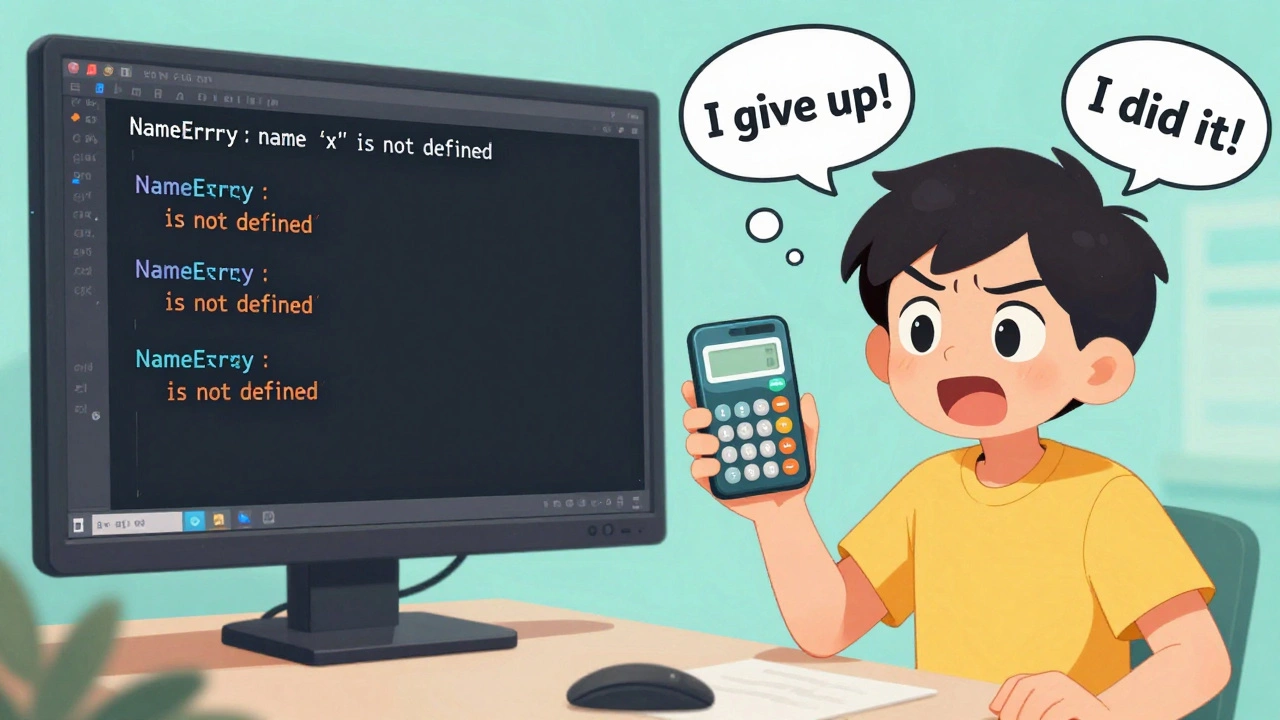
The hardest part of learning to code isn’t syntax. It’s dealing with errors. You’ll see messages like "SyntaxError: invalid syntax" or "NameError: name 'x' is not defined." At first, they feel like personal attacks. But they’re not. They’re clues. Every error is a puzzle waiting to be solved.
Think of it like learning to drive. You don’t start on the highway. You practice in an empty parking lot. Coding is the same. Your first programs will break. Constantly. And that’s okay. In fact, it’s how you learn. The people who stick with coding aren’t the smartest-they’re the ones who keep trying after 10 failed attempts.
What actually helps beginners succeed
Here’s what works for the people who make it past the first month:
- Build something small, then make it bigger. Start with a to-do list app, then add due dates. Then add reminders. Then let friends add tasks. Each step teaches you something new.
- Use free tools that give instant feedback. Websites like Replit or Codecademy let you write code and see results right away. No installing software. No command lines. Just type and run.
- Copy, then change. Don’t feel guilty about copying code from tutorials. That’s how every programmer learned. The trick is to change one thing-swap a color, rename a button, add a new line-and see what happens.
- Ask for help early. Join a free coding community like freeCodeCamp or Reddit’s r/learnprogramming. Most people there were beginners last month. They remember what it felt like.
How long does it take to get good?
There’s no magic number. But here’s what real data shows:
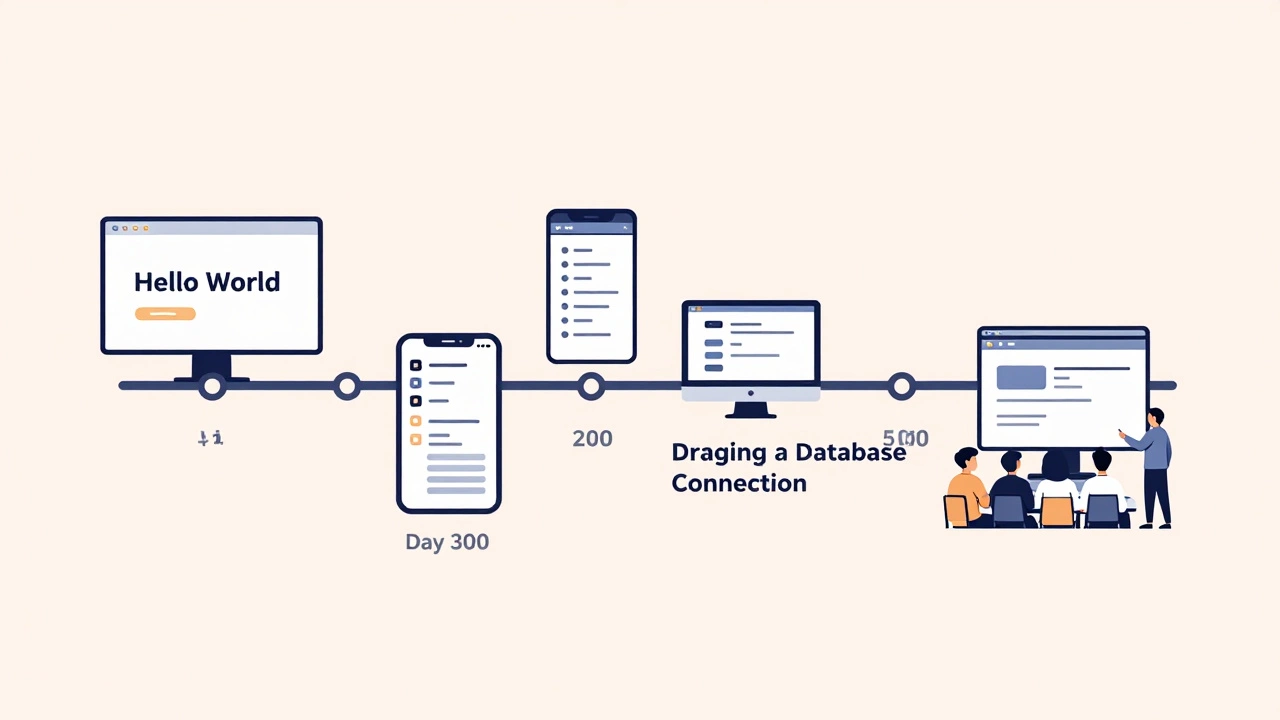
- After 40 hours of focused practice, most beginners can build a working website or simple app.
- After 200 hours, they can fix bugs on their own and understand how databases work.
- After 500 hours, they’re comfortable enough to apply for junior roles.
That’s not years. That’s a few hours a week for 3-6 months. Most people quit before 50 hours because they expect to build an app like Instagram in a week. That’s not how it works.
What coding classes actually teach you
Good coding classes don’t teach you every command. They teach you how to think like a programmer. That means:
- Breaking big problems into tiny pieces
- Testing one thing at a time
- Not being afraid to start over
- Knowing where to look when you’re stuck
Many free coding classes (like those on YouTube or Coursera) focus too much on theory. The best ones make you build something real by lesson three. Look for classes that say: "By the end of this module, you’ll have a working calculator"-not "You’ll learn about loops."
What doesn’t work (and why people give up)
Here’s what most beginners try-and why it fails:
- Watching 10-hour tutorials without typing anything. You can’t learn to swim by watching videos. Same with coding.
- Switching languages every week. Python, JavaScript, Java-they’re all tools. Pick one. Stick with it for three months.
- Trying to learn HTML, CSS, JavaScript, React, and Node.js all at once. That’s like trying to learn to drive, fix the engine, and design the car on day one.
- Comparing yourself to people who’ve been coding for 10 years. You wouldn’t compare your first piano lesson to a concert pianist. Don’t do it with code.
Real examples from real beginners
A 42-year-old teacher in Sydney started coding after her school switched to digital report cards. She used freeCodeCamp for 30 minutes a day. Three months later, she built a tool that auto-filled student grades. She shared it with her team. Now, she’s teaching others.
A 17-year-old in Perth wanted to make a game for his little sister. He used Scratch, then moved to Python. He didn’t know what a variable was at first. Now, he’s building his own mobile app.
They didn’t have special talent. They just showed up every day.
Where to start today
If you’re serious about learning, here’s your first week:
- Day 1: Go to freeCodeCamp and complete the first 3 lessons. No signup needed.
- Day 2: Write a program that prints your name 5 times.
- Day 3: Change it to print your favorite food instead.
- Day 4: Add a line that says "I’m learning to code!"
- Day 5: Try to make it ask you what your favorite food is-and use your answer.
- Day 6: If you get stuck, copy a solution from a tutorial. Then change one thing.
- Day 7: Celebrate. You just wrote code. That’s more than most people ever do.
Coding isn’t hard. It’s just unfamiliar. And unfamiliar things feel hard until they don’t.
Is coding hard if you’re not good at math?
No. Most beginner coding tasks involve basic logic, not advanced math. You’ll use simple addition, comparisons, and conditions-not calculus or trigonometry. If you can balance a budget or follow a recipe, you have the skills needed to start coding.
How many hours a week should I practice?
Three to five hours a week is enough to make steady progress. Consistency matters more than intensity. If you code for 30 minutes every day, you’ll learn faster than someone who crams 10 hours once a week. The goal isn’t to finish fast-it’s to build the habit.
Which programming language should I learn first?
Start with Python. It’s clear, readable, and used in everything from websites to data analysis. It’s also the most common language taught in beginner coding classes. Once you understand the logic, switching to JavaScript, Java, or another language is much easier.
Can I learn coding without a degree?
Absolutely. Many entry-level coding jobs don’t require a degree. Employers care more about what you can build than where you went to school. A portfolio of real projects-like a personal website, a simple app, or a data tracker-will get you farther than a diploma.
What if I get stuck and can’t fix my code?
Everyone gets stuck-even experienced developers. The key is to learn how to search. Copy the exact error message into Google. Look for answers on Stack Overflow or freeCodeCamp forums. If you’re still stuck, post your code in a beginner community. Most people are happy to help. Asking for help isn’t failure-it’s part of the process.