What Are the 4 Best Online Learning Platforms in 2026?
When you’re trying to learn something new-whether it’s coding, business strategy, or how to speak Spanish-you don’t need to enroll in a university or pay thousands for a course. All you need is an internet connection and one of the top four online learning platforms that millions of people trust every day. These aren’t just websites. They’re full ecosystems built around real learning, real instructors, and real outcomes. And in 2026, four of them stand far above the rest.
Coursera: Learn from Top Universities
Coursera is where you go when you want to learn from Stanford, Yale, or the University of London. It partners directly with universities and companies like Google and IBM to offer accredited courses, specializations, and even full online degrees. You won’t just watch videos-you’ll submit assignments, take graded quizzes, and earn certificates that show up on your LinkedIn profile. The platform is especially strong in data science, business, and IT. A Coursera specialization in machine learning, for example, takes about six months to complete and includes hands-on projects using real datasets. Over 135 million learners have used it since its launch in 2012, and more than 70% of them say it helped them get a new job or promotion.
Udemy: Learn Anything, Anytime
If Coursera feels like a university, Udemy feels like a marketplace. Anyone can create a course here-from a freelance graphic designer to a retired software engineer. That means you’ll find thousands of niche topics you won’t see anywhere else: how to build a Shopify store, how to edit TikTok videos, even how to train your parrot. The downside? Quality varies. But the upside? You can often buy a course for under $20 during sales. Udemy’s algorithm surfaces popular courses based on ratings, so you can usually tell which ones are worth it. Over 57 million students have taken a course here, and the platform offers lifetime access to everything you buy. No subscription needed. Just pay once, learn forever.
edX: Free Learning with Academic Rigor
edX started as a nonprofit project from MIT and Harvard. Even today, it keeps that academic soul. Most courses here are free to audit-you can watch lectures, read materials, and participate in forums without paying a cent. If you want a certificate or graded assignments, you pay a fee, usually between $50 and $300. What sets edX apart is its focus on verified learning. You’ll find full microbachelors programs, professional certificates from companies like Microsoft, and even courses that count toward college credit. It’s the go-to platform if you’re serious about learning but don’t want to commit to a full degree. In 2025, edX added AI-powered learning paths that adapt to your progress, making it smarter than ever.
Khan Academy: Free, Simple, and Perfect for Beginners
Khan Academy isn’t flashy. There’s no sales pitch. No premium tiers. No corporate sponsors pushing their products. It’s just free, high-quality education for everyone. Founded in 2006 by Salman Khan, it started with math tutorials on YouTube and grew into a full curriculum covering math, science, economics, computing, and even test prep for SAT and AP exams. It’s used by over 150 million students worldwide. The interface is clean, the videos are short (usually under 10 minutes), and the exercises are interactive. If you’re a high school student trying to catch up on algebra, a parent helping your kid with fractions, or an adult restarting your math skills-this is your platform. No credit card needed. No sign-up required. Just open it and start learning.
Why These Four?
There are hundreds of online learning sites out there. So why focus on these four? Because they cover the full spectrum of what you might need.
- If you want academic credibility → Coursera or edX
- If you want affordable, practical skills → Udemy
- If you want completely free, no-pressure learning → Khan Academy
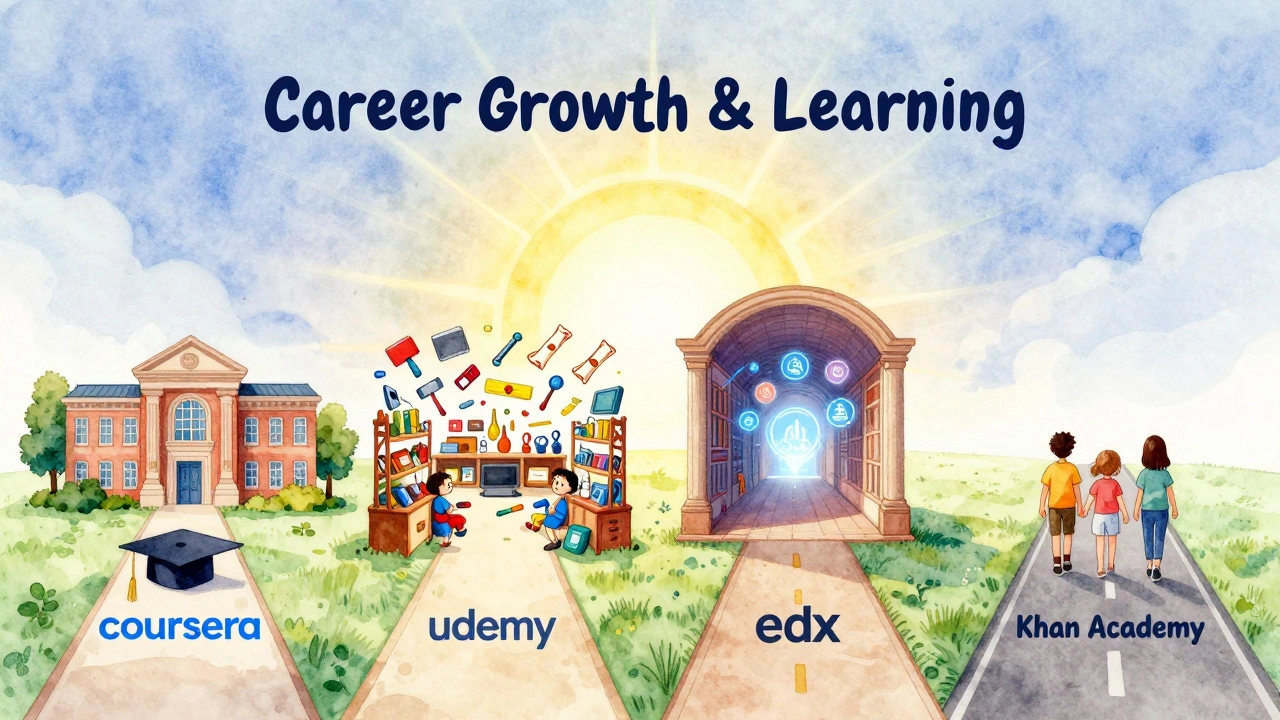
Each one solves a different problem. Coursera helps you advance your career. Udemy helps you pick up a new hobby or side hustle. edX lets you test-drive university-level learning. Khan Academy removes every barrier to learning basics.
You don’t need to use all four. But if you’re serious about learning, at least one of them should be in your toolkit.
What to Avoid
Not all platforms are created equal. Stay away from sites that:
- Only offer vague “certificates” with no recognition
- Require monthly subscriptions just to access one course
- Have no reviews, no instructor info, or no course outline
- Promote “get rich quick” schemes disguised as courses
These are often low-quality or outright scams. Stick to platforms with clear pricing, verified instructors, and real student feedback.
How to Choose the Right One
Ask yourself three questions before picking a platform:
- What’s your goal? Job promotion? Career change? Just curiosity?
- How much are you willing to spend? Free? $20? $1,000?
- Do you need a certificate, or is learning enough?
If you’re aiming for a promotion, go with Coursera or edX. If you’re learning to edit videos for fun, Udemy’s your best bet. If you’re helping your child with homework, Khan Academy is all you need.
| Feature | Coursera | Udemy | edX | Khan Academy |
|---|---|---|---|---|
| Cost to Start | $49-$79/month (subscription) | $10-$20 per course | Free to audit; $50-$300 for certificate | Free |
| Course Types | University degrees, specializations, professional certs | Skills, hobbies, software, business | Microbachelors, university courses, corporate certs | Math, science, computing, test prep |
| Certificates | Yes, recognized by employers | Yes, but less formal | Yes, often credit-eligible | No |
| Best For | Career advancement | Practical skills | Academic rigor | Foundational learning |
| Student Base | 135M+ | 57M+ | 40M+ | 150M+ |
Real Stories
A 32-year-old nurse in Melbourne took a Coursera course in healthcare informatics. Six months later, she moved into a new role managing patient data systems-her salary went up 30%. A college student in Sydney learned web development on Udemy for under $15 during a sale. By her second year, she was freelancing part-time. A high schooler in Brisbane used Khan Academy every night to prepare for her AP Calculus exam-and scored a 5. These aren’t rare cases. They’re common outcomes.
Final Thoughts
You don’t need a degree to get ahead. You just need the right tools. The four platforms above aren’t just popular-they’re proven. They’ve helped millions of people change careers, build skills, and unlock opportunities without stepping into a classroom. Whether you’re starting from scratch or leveling up, one of these will match your needs. Pick the one that fits your goal. Start today. And don’t wait for the perfect time-there’s no such thing.
Are online learning certificates worth anything?
Yes-but only if they come from credible platforms. Coursera and edX certificates are recognized by employers because they’re tied to universities or major companies. Udemy certificates show initiative but aren’t as formal. Avoid platforms that sell certificates with no course content or reviews. Always check if the certificate can be verified online.
Can I learn coding for free?
Absolutely. Khan Academy offers full courses in JavaScript, HTML, and Python. edX has free intro courses from MIT and Harvard. Even Udemy has free coding tutorials-just search for "free coding" and filter by rating. You don’t need to pay to learn to code. You just need to practice.
Which platform is best for non-native English speakers?
Khan Academy and edX offer subtitles in over 50 languages. Coursera has auto-translated subtitles for most courses. Udemy courses vary-some instructors provide subtitles, others don’t. Stick to platforms with strong accessibility features if English isn’t your first language.
Do I need to pay monthly to use these platforms?
Only Coursera requires a subscription for full access. Udemy and edX let you pay per course. Khan Academy is completely free. You can avoid monthly fees entirely by choosing one-time purchases or free courses.
What if I get stuck in a course?
All four platforms have discussion forums. Coursera and edX have peer-reviewed assignments and teaching assistants. Khan Academy uses step-by-step hints and practice exercises. Udemy lets you message instructors directly. Don’t give up-help is always there.