What is the Number 1 Hardest Subject in CBSE? A Real Talk Guide
CBSE Subject Difficulty & Strategy Quiz
Discover which subject is considered the hardest in CBSE and test your understanding of why students struggle with specific topics. This interactive quiz highlights key insights from student sentiment and exam data.
Loading question...
Quiz Complete!
You scored 0 out of 5.
You’ve probably heard it whispered in school corridors or shouted on social media forums: "Physics is impossible," or "Maths will break your brain." But if you had to pick just one hardest subject for a CBSE student, who wins the crown? The truth is, there’s no single scientific answer because difficulty is personal. However, when we look at data from board exam results, coaching center dropout rates, and general student sentiment across India, Physics consistently tops the list as the most feared discipline in the Central Board of Secondary Education (CBSE) curriculum.
Why does this specific subject cause so much panic? It’s not just about memorizing formulas. Unlike History or Biology, where understanding the narrative helps you pass, Physics demands a unique blend of abstract visualization, mathematical precision, and logical reasoning. If you miss one step in a derivation, the whole problem collapses. This article breaks down why Physics takes the top spot, how other tough subjects like Mathematics and Chemistry compare, and what you can actually do about it without pulling an all-nighter every week.
Why Physics Takes the Crown
Let’s be real. When students say they are struggling, they usually point to the subject that requires them to see things they cannot touch. Physics deals with forces, fields, and particles that exist in theory but require rigorous calculation to prove their behavior in reality. In the CBSE Class 11 and 12 syllabus, topics like Rotational Motion, Electromagnetic Induction, and Optics are notorious for having low average scores in national mock tests.
The core issue isn't the complexity of the English language used in textbooks; it's the cognitive load. You have to translate a word problem into a free-body diagram, then convert that diagram into equations, and finally solve those equations using calculus or algebra. If your math foundation is shaky, Physics becomes exponentially harder. This dependency chain makes it feel heavier than subjects that stand alone. For many students, it feels less like learning science and more like solving puzzles where the rules change depending on the frame of reference.
The Math vs. Physics Debate
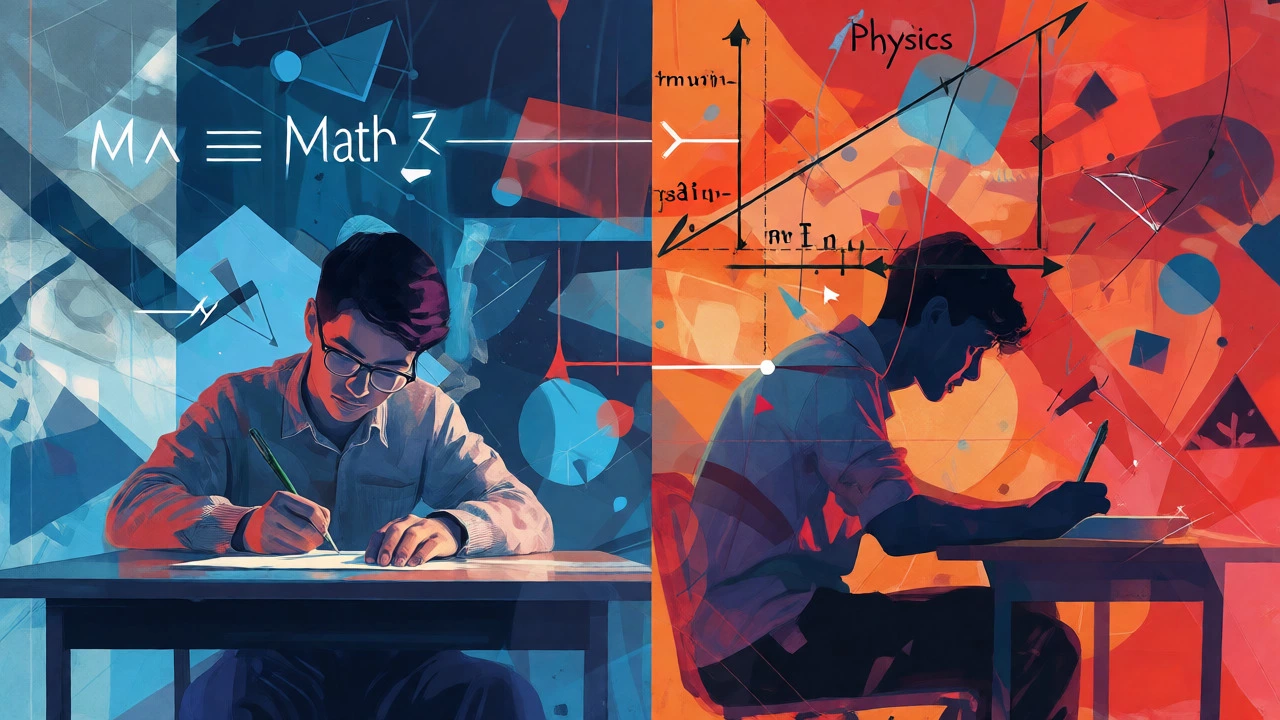
Is Mathematics harder than Physics? This is the classic debate. In terms of pure abstraction, Advanced Mathematics-specifically Calculus and Vectors-can be brutal. However, Mathematics in CBSE follows a more predictable pattern. Once you master a method, you can apply it to similar problems repeatedly. Physics is different. Two problems might use the same formula, but the physical setup changes everything. A block sliding down an inclined plane behaves differently if friction is involved versus if it’s smooth. Small changes in context require big shifts in thinking.
According to recent trends in CBSE evaluation reports, while Math has high failure rates due to silly mistakes or incomplete steps, Physics has higher rates of "conceptual blanks" where students simply don’t know where to start. That uncertainty creates more anxiety. If you are good at logic but bad at drawing diagrams, Physics will punish you. If you are good at patterns but bad at visualizing 3D space, Math might still be manageable. This nuance is why Physics often retains the title of the most difficult subject for the average student.
Chemistry: The Silent Killer
While Physics gets the headlines, Organic Chemistry is often the silent killer for students aiming for medical entrance exams like NEET. Organic Chemistry is a branch of chemistry that deals with carbon-based compounds, requiring a deep understanding of reaction mechanisms rather than rote memorization. In CBSE Class 12, the chapter on Aldehydes, Ketones, and Carboxylic Acids trips up many students because the reactions don’t always follow simple rules.
Unlike Physics, where you can derive answers logically, Organic Chemistry requires you to remember exceptions. Why does one reagent attack here and another there? Sometimes, it’s just "because that’s how nature works." This lack of clear logical derivation frustrates analytical minds. However, compared to Physics, Chemistry is often seen as more forgiving if you put in the time to practice named reactions. It’s tedious, yes, but less mentally taxing in terms of abstract visualization.
Biology: Volume Over Complexity
Many students think Biology is easy because it’s "just biology." They’re wrong. The difficulty here isn’t conceptual depth; it’s sheer volume. The CBSE Biology syllabus requires precise terminology and detailed knowledge of processes like Photosynthesis, Respiration, and Genetics. One small error in labeling a diagram or misusing a term like "homologous" instead of "analogous" can cost marks.
For students who prefer storytelling, Biology is a breeze. For those who hate memorization, it’s a nightmare. But generally, it doesn’t induce the same level of existential dread as Physics. You can guess your way through some Biology questions based on common sense. Try guessing your way through a question on Kirchhoff’s Laws, and you’ll likely end up with zero marks. That safety net is missing in hard sciences.
Subject Difficulty Comparison Table
To help you visualize where you stand, here is a breakdown of the main subjects in the CBSE Science stream based on common student pain points.
| Subject | Main Challenge | Mental Load | Common Pitfall |
|---|---|---|---|
| Physics | Abstract visualization & math application | Very High | Incorrect free-body diagrams |
| Mathematics | Complex calculations & multiple steps | High | Silly arithmetic errors |
| Chemistry | Memorizing exceptions & mechanisms | Medium-High | Confusing similar reactions |
| Biology | Vast syllabus & precise terminology | Medium | Missing key keywords |
It’s Not Just About IQ
Here is a controversial idea: Your struggle with Physics might not mean you aren’t smart. It might mean your teaching method didn’t click. Many schools teach Physics by throwing formulas at students first, then asking them to apply them later. This backward approach kills intuition. When you understand *why* a ball accelerates before you calculate *how fast* it goes, the subject becomes easier.
Consider this: Some of the world’s best engineers struggled with Physics in school. The difference wasn’t talent; it was perspective. They stopped trying to memorize solutions and started building mental models. If you find yourself stuck, try changing your input source. Watch a simulation online. Play around with variables. See what happens when you increase mass or decrease gravity. Making the abstract concrete reduces fear.
How to Tackle the Hardest Subject
If you accept that Physics (or whichever subject scares you) is the boss level, how do you beat it? You don’t grind blindly. You strategize.
- Master the Basics First: Don’t jump to rotational motion if you don’t understand Newton’s laws. Go back to Chapter 1. Seriously. Most advanced problems fail because of basic misconceptions.
- Draw Everything: Never solve a Physics problem in your head. Draw the diagram. Label the forces. Write the knowns and unknowns. Visualizing the problem reduces cognitive load.
- Practice Derivations: CBSE loves derivations. Instead of memorizing the final formula, learn how it’s derived. If you forget the formula in the exam, you can often reconstruct it quickly.
- Focus on Concepts, Not Questions: Solving 50 similar questions is better than solving 500 random ones. Understand the pattern. Once you get the concept, the numbers don’t matter.
Context Matters: Stream Selection
Your perception of difficulty also depends on your stream. For Commerce students, Accountancy is often cited as the hardest subject due to its rigid rules and complex adjustments. For Arts/Humanities students, Political Theory or Psychology can be challenging due to the need for critical analysis and essay writing skills. However, since the query specifically targets the general "hardest subject" reputation in Indian education contexts, the Science stream dominates the conversation.
If you are in Class 9 or 10, you might think Science is easy right now. Wait until Class 11. The jump in difficulty is steep. Topics go from descriptive to analytical overnight. This transition shock is why many students drop out of science streams after Grade 11. Recognizing this early helps you prepare mentally.
Final Thoughts on Difficulty
So, is Physics really number one? For most students, yes. It combines the worst parts of Math and the abstractness of Philosophy. But remember, difficulty is subjective. A student with strong spatial intelligence might find Geometry easy but struggle with Algebra. Another student might love Organic Chemistry’s logic but hate Physics’ unpredictability.
Don’t let the label scare you. The goal isn’t to prove which subject is objectively hardest. The goal is to identify where you struggle and address it with the right tools. Whether it’s finding a better tutor, switching to video lectures, or forming a study group, action beats anxiety. Pick up that textbook, draw that diagram, and take it one problem at a time.
Which is harder, CBSE Physics or JEE Physics?
JEE Physics is significantly harder than CBSE Physics. While CBSE focuses on standard applications and derivations, JEE involves multi-concept problems, deeper mathematical integration, and trickier scenarios. However, mastering CBSE concepts is the prerequisite for tackling JEE-level questions.
Can I score full marks in Physics if I am weak in Math?
Yes, but it requires extra effort. Physics relies heavily on Algebra, Trigonometry, and Calculus. If your Math is weak, spend time strengthening these specific areas. You don’t need to be a mathematician, but you must be comfortable manipulating equations and understanding graphs.
Is Biology easier than Chemistry for CBSE students?
Generally, yes. Biology is considered easier because it is more descriptive and less dependent on complex calculations. However, scoring full marks in Biology is tough because of the need for precise terminology and detailed diagram labeling. Chemistry requires logical consistency and memory of reactions, which some students find harder than memorizing biological processes.
Why do students find Organic Chemistry so difficult?
Students struggle with Organic Chemistry because it requires understanding electron movement and reaction mechanisms rather than just memorizing outcomes. Many reactions have exceptions, and predicting products can be counter-intuitive. Without a strong grasp of basic principles like electronegativity and stability, it feels like arbitrary rule-following.
Does the difficulty of subjects vary by CBSE region?
The syllabus and question paper pattern are uniform across India, so the inherent difficulty of the content does not change. However, the quality of local teaching resources and peer support networks varies by city and state, which can affect how difficult a student perceives the subject to be.