Which board is best for kids' future? CBSE vs ICSE vs State Boards explained
When parents ask which board is best for kids’ future, they’re not just picking a curriculum. They’re choosing a path that shapes how their child thinks, learns, and prepares for life after school. In India, three major boards dominate: CBSE, ICSE, and state boards. Each has strengths, weaknesses, and hidden trade-offs that can make a real difference in a child’s academic journey - and long-term opportunities.
What CBSE actually offers
CBSE, or the Central Board of Secondary Education, is the most popular board in India, with over 20,000 affiliated schools. It’s the go-to for families who plan to take competitive exams like JEE, NEET, or even civil services later. Why? Because CBSE’s syllabus is designed around those tests. The focus is on science, math, and logical reasoning. Textbooks are clear, exam patterns are predictable, and the grading is standardized across the country.
For example, a 10th-grade CBSE student studying physics will cover the same chapters and numerical problems as a student in Delhi, Pune, or Guwahati. That uniformity helps when applying to national colleges. CBSE also uses NCERT textbooks, which are the foundation for JEE and NEET preparation. Many coaching institutes base their entire curriculum on NCERT content. So if your child aims for an IIT or AIIMS, CBSE gives them a head start.
But there’s a cost. CBSE leans heavily on rote learning. Students often memorize formulas and answers instead of exploring why things work. Creative writing, deep analysis, and open-ended projects are rare. If your child thrives on discussion, storytelling, or questioning ideas, CBSE might feel too rigid.
How ICSE compares
ICSE, or the Indian Certificate of Secondary Education, runs a tighter, more detailed curriculum. It’s managed by CISCE and is known for its emphasis on English, literature, and critical thinking. ICSE students read more novels, write longer essays, and engage with complex texts than their CBSE peers. The syllabus covers history, geography, and science with more depth - sometimes even more than state boards.
Take biology. In CBSE, a chapter on human physiology might be 15 pages. In ICSE, it’s 30 pages - with diagrams, case studies, and real-world applications. The exam papers reflect this too. ICSE questions ask you to explain, compare, and justify - not just recall. That builds communication skills and analytical thinking early.
But ICSE isn’t ideal for everyone. The workload is heavier. A 10th-grade ICSE student might spend 5-6 hours a day on homework, compared to 3-4 for CBSE. And while ICSE is respected globally, it doesn’t align as directly with JEE or NEET. Students switching from ICSE to engineering coaching often need extra months to catch up on the math and physics focus.
State boards: the overlooked option
State boards vary wildly - from Maharashtra’s MSBSHSE to Tamil Nadu’s Samacheer Kalvi. But they share common traits: they’re deeply tied to local culture, language, and job markets. In states like Karnataka or Kerala, state board students often outperform CBSE peers in regional university entrance exams. They learn in their mother tongue until class 8, which helps with early comprehension.
For families who plan to stay in their home state, state boards can be the smartest choice. The syllabus is simpler, the competition is less intense, and students often score higher in board exams. In Tamil Nadu, for instance, over 80% of medical college seats go to state board students because the state exam system prioritizes them.
The downside? Mobility. If you move cities or plan to apply to national colleges, state board marks don’t always translate well. A 95% in a state board might not carry the same weight as 90% in CBSE when applying to IITs or NITs. Also, resources like coaching centers, online prep tools, and study materials are less available.
What really matters for your child’s future
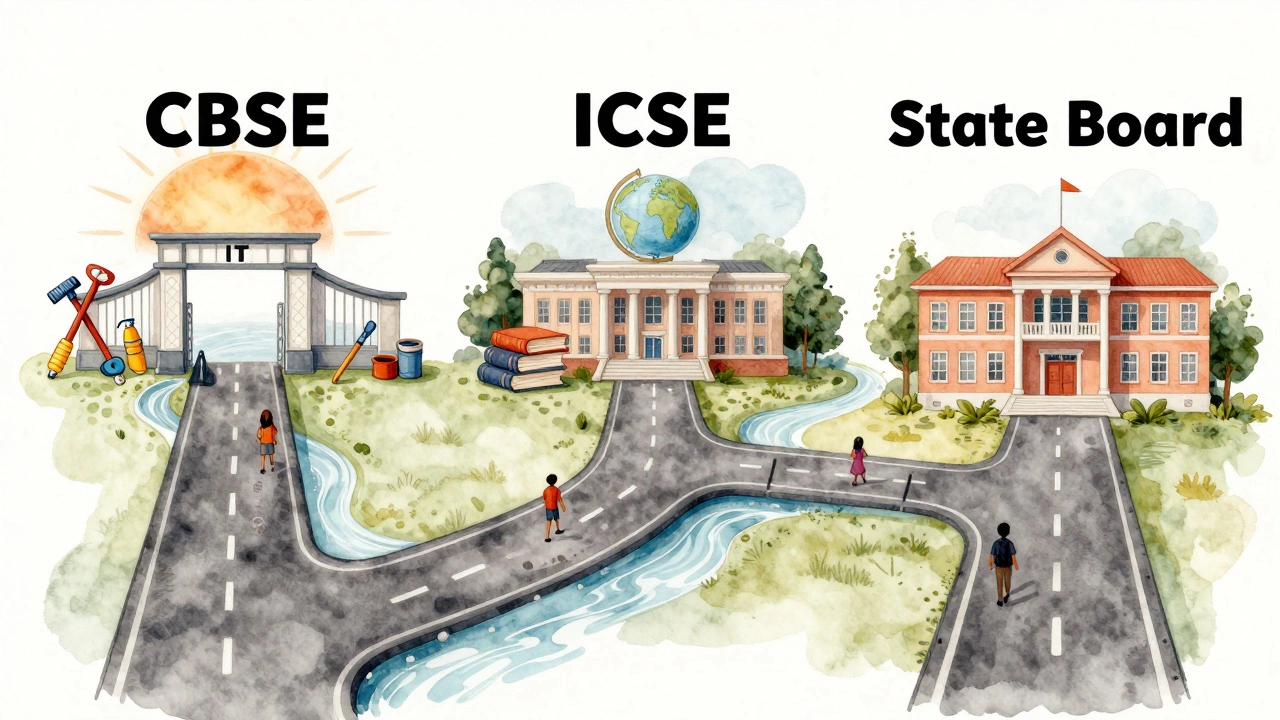
Board choice isn’t about prestige. It’s about fit. Ask yourself:
- Does your child learn better through memorization or discussion?
- Are they aiming for engineering, medicine, or something outside the STEM path?
- Will you move cities or stay put?
- Do they speak English confidently, or do they need time to build fluency?
Here’s the truth: CBSE is best if your child is targeting national competitive exams. It’s the most direct route to IITs, AIIMS, and government jobs. But if your child loves reading, writing, or wants to study abroad later, ICSE gives them stronger language skills and critical thinking habits that last beyond exams.
State boards? They’re perfect if you’re staying local. In many states, state board students get preferential treatment in admissions, scholarships, and even government job quotas. Plus, the lower pressure means kids have more time for hobbies, sports, or family.
The hidden advantage: flexibility after class 10
Many parents don’t realize that board choice matters most before class 10. After that, the board fades in importance. What matters is what you do after class 12.
A CBSE student who joins a coaching institute for JEE and scores 98% in the entrance exam will get into IIT - no matter their board. An ICSE student who builds a startup, wins a national science fair, or publishes research will get into Stanford or Oxford - even if their board marks are lower.
Board is just the starting line. The race is what comes after.

Real-world outcomes: What do the numbers say?
According to data from the National Institutional Ranking Framework (NIRF) and NTA, over 70% of students who clear JEE Advanced come from CBSE-affiliated schools. Why? Because CBSE syllabi align with JEE’s structure - especially in physics and math.
Meanwhile, a 2025 survey by the Indian Council for Educational Research found that ICSE students scored 15% higher on English proficiency tests and 22% higher in analytical reasoning tasks than CBSE peers. That gap doesn’t disappear after class 12 - it grows.
State board students, on the other hand, dominate regional university rankings. In Kerala, 89% of engineering college seats are filled by state board candidates. In Maharashtra, state board students make up 63% of medical college admissions.
So the answer isn’t one-size-fits-all. It’s about where your child is going - not where everyone else is going.
What about international options?
If you’re considering education abroad, ICSE is the most recognized board globally. Universities in the UK, Canada, and Australia treat ICSE as equivalent to GCSE or IGCSE. CBSE is accepted too, but often requires additional documentation or language tests.
State boards? Most international universities don’t recognize them directly. A student from a state board would need to take an IGCSE, IB, or SAT to apply abroad. That adds cost and complexity.
So if global education is on the table, ICSE gives you the smoothest transition. But if you’re not sure, CBSE still works - just plan ahead.
Final decision checklist
- Choose CBSE if: Your child wants to crack JEE, NEET, or government exams. You’re okay with a structured, exam-focused environment. You might move cities.
- Choose ICSE if: Your child loves reading, writing, and deep thinking. You’re open to global education. You’re okay with a heavier workload.
- Choose state board if: You plan to stay in your state. Your child learns better in their mother tongue. Local colleges or jobs are the goal.
There’s no perfect board. But there’s a perfect fit - for your child.
Is CBSE better than ICSE for engineering?
Yes, CBSE is generally better for engineering aspirants because its syllabus directly matches the JEE pattern. The math and physics topics are taught in the same sequence and depth as the entrance exam. Most coaching institutes use NCERT textbooks - which are CBSE’s core material. ICSE covers more concepts, but not always in the way JEE tests them. CBSE students typically need less adjustment when starting JEE prep.
Can ICSE students crack JEE?
Absolutely. Many top JEE rankers come from ICSE schools. The difference isn’t ability - it’s alignment. ICSE students often need 2-3 extra months to adjust to the JEE-style problem-solving format because their curriculum emphasizes understanding over speed. But once they adapt, they perform just as well - and often better in the long run because of their stronger analytical skills.
Are state board students at a disadvantage for national exams?
They can be, but not because they’re less capable. State board syllabi vary widely, and many don’t cover the full JEE or NEET syllabus. A student from a state board might miss key topics like dimensional analysis or modern physics unless they self-study. That’s why many state board students join coaching institutes early. With proper guidance, they clear national exams just as easily as CBSE students.
Which board is easiest to score high in?
State boards are usually the easiest to score high in. The exams are less competitive, the marking is more lenient, and the syllabus is narrower. CBSE is moderate - predictable but challenging. ICSE is the hardest to score high in because questions demand detailed explanations, not just correct answers. But high scores aren’t everything - depth matters more in the long run.
Should I switch boards after class 8?
Switching boards after class 8 is possible, but risky. The curriculum changes significantly between class 9 and 10. A student moving from ICSE to CBSE might struggle with the sudden shift from essay-based questions to multiple-choice and short-answer formats. The reverse is also hard - CBSE students often find ICSE’s depth overwhelming. Only switch if you have a clear reason - like moving abroad or targeting a specific exam - and give them at least 6 months to adjust.