Which Faculty Is Best for NEET? Top Choices for Medical Aspirants
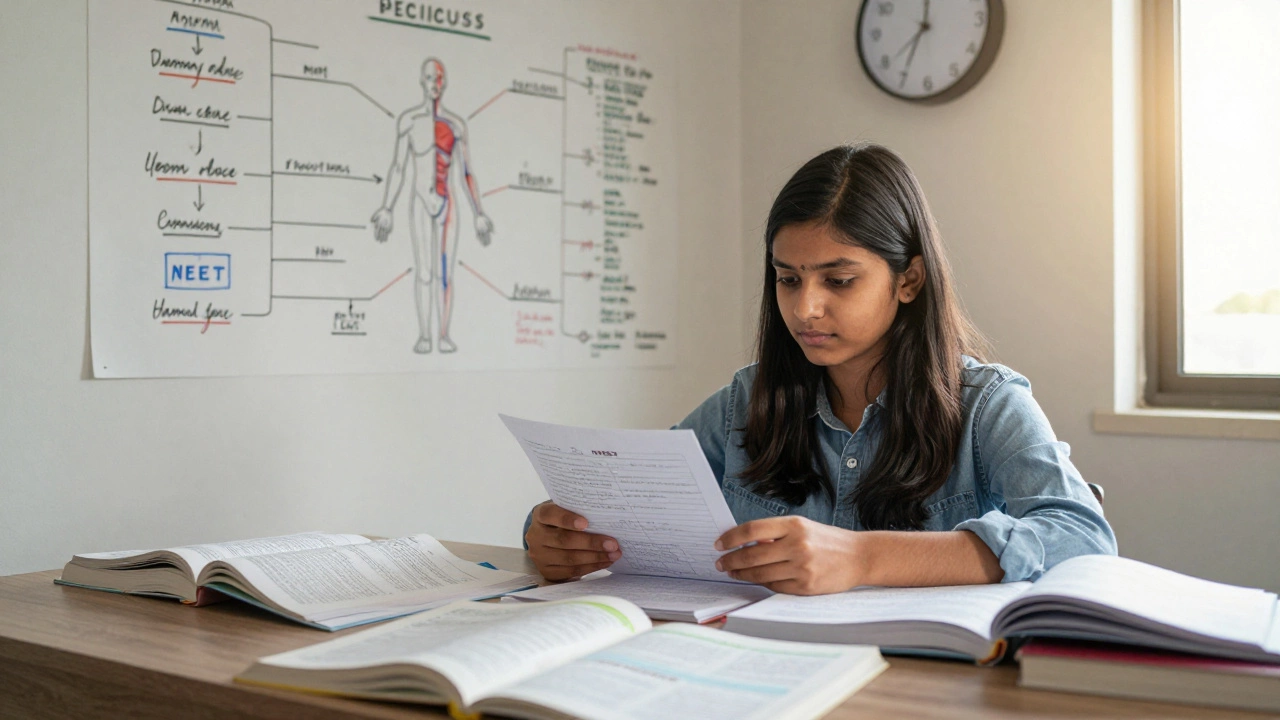
Choosing the right faculty for NEET isn’t about picking the most famous name or the biggest coaching center. It’s about finding teachers who actually help you understand biology, chemistry, and physics the way the exam demands. Thousands of students show up every year expecting miracles from a single coaching institute, only to end up confused, burned out, or worse - underprepared. The truth? The best faculty for NEET isn’t always the one with the most ads. It’s the one that gets you to think like a doctor, not just memorize like a robot.
What Makes a Faculty ‘Best’ for NEET?
There’s no official ranking for NEET faculty. But if you talk to students who scored above 650, you’ll hear the same things over and over: clarity, consistency, and connection. A good NEET faculty doesn’t just teach the syllabus - they teach you how to solve questions fast, spot traps, and manage time under pressure.
Think about it: NEET has 180 questions in 3 hours. That’s less than a minute per question. If your teacher spends 20 minutes explaining a concept that appears once every three years, you’re wasting time. The best faculty knows exactly what’s high-yield and what’s fluff. They focus on NCERT-level depth, past trends, and repeated patterns - not theoretical tangents.
Also, don’t confuse popularity with effectiveness. A teacher with 100,000 YouTube subscribers might sound impressive, but if their notes don’t match the latest NTA pattern or they skip important topics like human physiology or organic reaction mechanisms, you’re at risk.
Subject-Specific Faculty: Where to Focus
NEET isn’t a single exam. It’s three exams in one: Biology, Chemistry, and Physics. Each needs a different kind of teacher.
Biology: The King of NEET
Biology makes up 50% of your score. No one can crack NEET without mastering it. The best biology faculty doesn’t just recite NCERT lines. They turn diagrams into stories. For example, instead of saying ‘the heart has four chambers,’ they’ll explain why the left ventricle is thicker - and how that connects to hypertension, a common NEET MCQ topic.
Look for teachers who emphasize:
- Human physiology (digestion, respiration, circulation)
- Genetics and inheritance patterns (Mendel’s laws, pedigree analysis)
- Plant morphology and taxonomy (commonly tested but often ignored)
- Reproduction in plants and animals (especially hormonal control)
These are the areas where 70% of the biology questions come from. If your faculty skips these, find someone else.
Chemistry: Balancing Memory and Logic
Chemistry is split into three parts: Physical, Organic, and Inorganic. Each needs a different approach.
Physical chemistry is about formulas and units. The best teachers here give you shortcuts - like how to quickly estimate pH without a calculator, or how to use the van’t Hoff equation without memorizing it. They also drill you on mole concept problems - the most frequent type in NEET.
Organic chemistry? Forget rote reactions. The best faculty teaches you to predict products by understanding electron flow. If they say ‘memorize this reaction,’ walk away. Look for teachers who use mechanisms like nucleophilic substitution or electrophilic addition to explain why reactions happen.
Inorganic chemistry is all about memory - but smart memory. The best teachers group elements by periodic trends, not by group number. They help you remember transition metal colors, oxidation states, and ligand fields through patterns, not flashcards.
Physics: Concept Over Calculation
Physics is the toughest subject for most NEET aspirants because it’s not just about formulas - it’s about application. A good physics faculty won’t just give you the formula for torque. They’ll show you how it applies to a human joint, or why a bicycle stays balanced.
Focus on these high-weightage topics:
- Electrostatics and current electricity (especially Kirchhoff’s laws)
- Magnetic effects of current and electromagnetic induction
- Optics (ray and wave)
- Modern physics (photoelectric effect, Bohr model, semiconductors)
These topics appear in 60-70% of physics questions. If your teacher spends two weeks on dimensional analysis or projectile motion (which rarely shows up), they’re misprioritizing.
How to Spot a Good Faculty - Red Flags and Green Flags
You don’t need to pay for a ‘star teacher’ to succeed. Here’s what to look for:
Green Flags
- They use NCERT as the base - not a 1,000-page book you’ve never heard of.
- They give you previous year questions as practice - not random questions from unknown sources.
- They explain why an answer is wrong, not just why it’s right.
- They track your progress and adjust their teaching - not just follow a fixed schedule.
- They encourage questions. No ‘stupid questions’ culture.
Red Flags
- They claim ‘guaranteed 700+ score’ - no one can guarantee that.
- They don’t update their material after 2023 - NEET patterns changed after NTA took over.
- They teach too fast - if you can’t take notes, you’re not learning.
- They ignore biology - some coaching centers treat it as an afterthought.
- They sell ‘secret notes’ or ‘exclusive tricks’ - if it’s not in NCERT, it’s not reliable.

Top Faculty Types That Actually Work
Not all teaching styles suit everyone. Here are the three types of faculty that consistently produce top scorers:
1. The NCERT Guru
This teacher lives and breathes NCERT textbooks. They know every line, every diagram, every footnote. They don’t add extra material - they drill you on what’s already there. Why does this work? Because 80% of NEET questions are directly or indirectly based on NCERT. If you master NCERT with this teacher, you’re already ahead of 70% of the competition.
2. The Pattern Analyst
This person has solved every NEET paper since 2015. They know which topics repeat, which options are distractors, and how NTA frames tricky questions. They don’t teach you everything - they teach you what matters. Their classes are short, sharp, and packed with real exam questions. They’ll say: ‘This exact concept appeared in 2022 and 2024 - you will see it again.’
3. The Doubt Crusher
This faculty makes time for individual questions. They don’t just lecture - they respond. If you’re stuck on a genetics problem, they don’t say ‘read the book.’ They sit with you, trace your mistake, and fix your thinking. This is rare, but it’s the most effective type. Many top scorers credit their success to one teacher who answered their 50th question at 8 PM.
Where to Find These Faculty Members
You don’t need to move to Kota. You don’t need to spend ₹1.5 lakhs. Many excellent faculty members teach online, in small cities, or even in local tuition centers.
Here’s how to find them:
- Join NEET Telegram groups - ask for recommendations from recent toppers.
- Watch 10-minute demo lectures - not hour-long ads.
- Check if the faculty has students who scored above 650 in the last two years.
- Ask for a sample test - if they can’t give you a real NEET-style paper, walk away.
- Look for teachers who still teach after 10 years - longevity means results.
Some names pop up often in forums - but don’t chase fame. A quiet teacher in Patna or Indore who knows the NTA pattern better than anyone in Delhi might be your best bet.

What to Do If You’re Already Enrolled
If you’re already in a coaching center and feel stuck, don’t wait till the last month. Talk to the faculty. Ask: ‘Can you explain this topic again, but in a way that connects to past NEET questions?’ If they brush you off, find a supplement.
Use free resources wisely:
- NCERT Biology Class 11 and 12 - read it twice, cover to cover.
- NEET previous year papers (2020-2025) - solve them under timed conditions.
- YouTube channels like ‘Biology by Dr. Anand’ or ‘Chemistry by Nitesh Choudhary’ - for quick doubt-solving.
Many students improve 100+ marks in their final attempt by switching faculty - not by studying more hours.
Final Thought: It’s Not About the Faculty. It’s About the Fit.
The best faculty for NEET is the one who fits your learning style, understands your weak spots, and pushes you just enough - without breaking you. A great teacher won’t make you feel smart. They’ll make you feel capable.
Don’t choose based on reputation. Choose based on results - your results. If after a month, you’re solving 10 more biology questions correctly than before, you’ve found your person. Keep going. Don’t look back.
Is coaching necessary to crack NEET?
No, coaching isn’t mandatory. Many students score above 650 with self-study using NCERT and past papers. But coaching helps if you need structure, doubt-clearing, and exam strategy. The key isn’t coaching - it’s consistency and smart practice.
Can I rely only on online faculty for NEET?
Yes, if the online faculty focuses on NCERT, past papers, and pattern analysis. Many top scorers use YouTube teachers like Dr. Anand (Biology), Nitesh Choudhary (Chemistry), and Preeti Mam (Physics). The trick is to avoid channels that sell courses - stick to those that give free, high-quality content.
Should I join a big coaching institute like Allen or Aakash?
Big institutes have resources, but not always the best faculty. Some teachers there are overworked and teach large batches. Many students get better results from smaller centers with focused teachers. Visit the center, talk to current students, and check if the faculty actually answers doubts - not just gives lectures.
What if my faculty doesn’t teach biology well?
Biology is non-negotiable. If your faculty skips it or teaches it poorly, use free YouTube resources daily. Dr. Anand’s NCERT-based lectures are trusted by thousands of NEET toppers. Supplement with NCERT exemplar problems. Don’t wait - fix it now, or your score will suffer.
How do I know if a faculty is updated with the latest NEET pattern?
Ask them: ‘Which question from the 2024 NEET paper did you include in your mock test?’ If they can’t name one, they’re outdated. The NTA now emphasizes application-based questions, especially in biology and chemistry. A good faculty will show you how old patterns changed in 2022-2025.